

New Data Reveals Top Student Struggles: Equilibrium and Stoichiometry Lead 18,000 Chemistry Queries
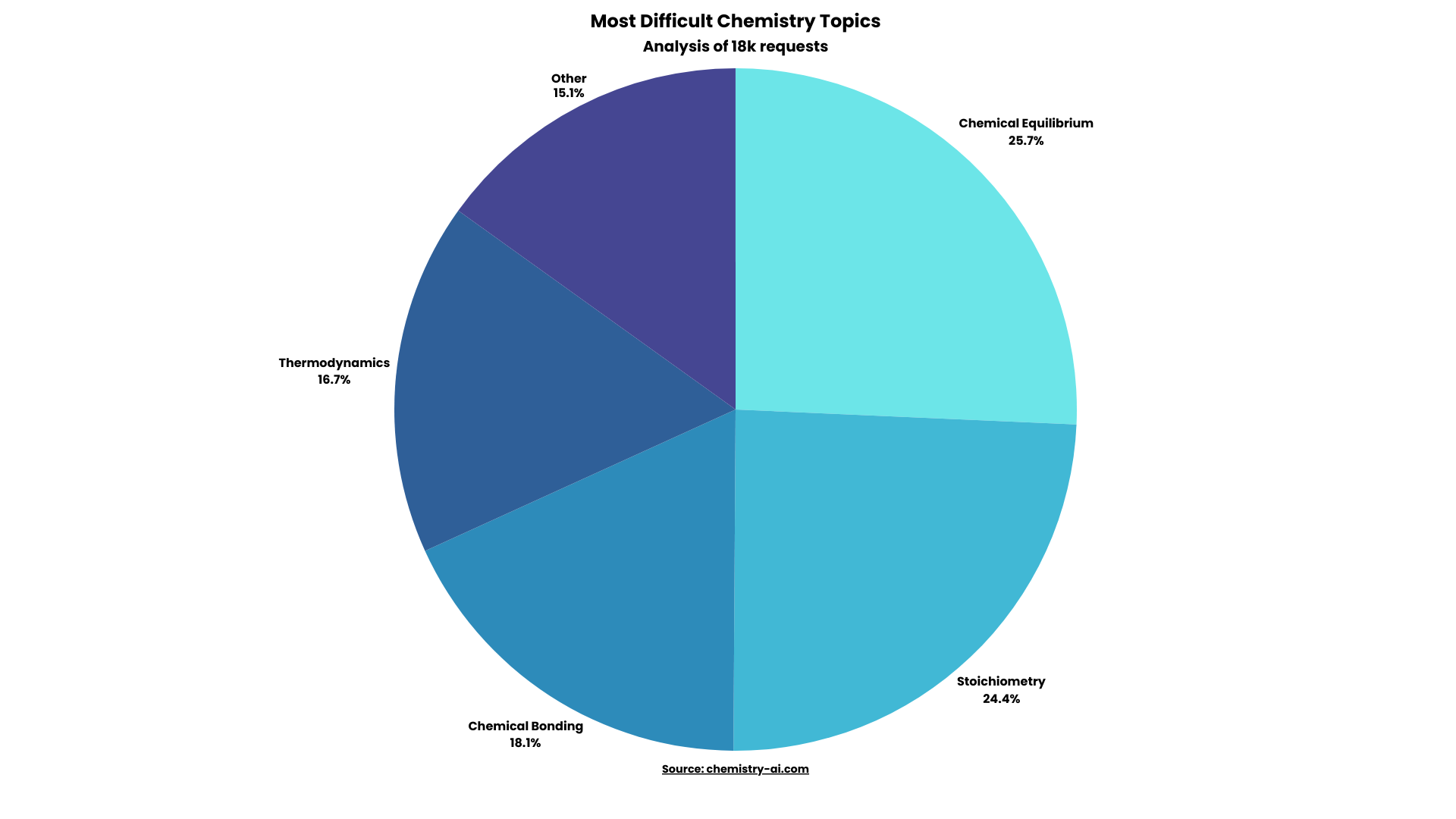
Distribution of student struggles in chemistry topics (Fall 2025 Data)
Analysis of Fall 2025 data shows a shift: over 40% of users are undergraduates seeking conceptual explanations rather than just calculation answers.
They aren't just looking for a quick answer. They are using the tool as a 24/7 personal tutor to explain the 'why' behind complex reactions.”
ALMATY, KAZAKHSTAN, December 15, 2025 /EINPresswire.com/ -- Chemistry AI, a rapidly growing educational technology platform, today released a comprehensive analysis of over 18,750 unique chemistry problems solved by its algorithm since September 2025. The data sheds light on the specific hurdles students face in the post-pandemic academic landscape, identifying Chemical Equilibrium (25.7%) and Stoichiometry (24.4%) as the most challenging topics for students worldwide.— Founder of Chemistry AI
Unlike general-purpose AI tools, the Chemistry AI Solver specializes exclusively in chemical sciences. This focus allowed the team to gather granular data on user intent. The findings contradict the common belief that students use AI solely to bypass homework. According to the report, 51.6% of queries sought "Conceptual Explanations," while only 28.8% were purely "Calculation Problems."
"We are seeing a fundamental shift in how students interact with AI," said the Founder of Chemistry AI. "They aren't just looking for a quick answer. They are using the tool as a 24/7 personal tutor to explain the 'why' behind complex reactions, specifically in high-difficulty areas like buffer solutions and titrations."
Key Findings from the Fall 2024 Report:
• University-Level Demand: The platform is not just for schools. 40.4% of users are University Undergraduates dealing with advanced Physical and Organic Chemistry topics.
• The "Struggle Zones": Besides Equilibrium and Stoichiometry, significant traffic was recorded in Chemical Bonding (18.1%) and Thermodynamics (16.7%).
• Complex Problem Solving: The analysis revealed that students struggle most with multi-step calculations involving weak acids/bases and applying theoretical models like VSEPR to predict molecular properties.
"The data showed us that users were getting stuck on the logic of Le Châtelier's Principle and Redox Reactions," the Founder added. "In response, we have optimized our algorithm to provide detailed, step-by-step breakdowns for these specific topics, rather than just generating a final number."
The platform successfully processed queries across all major disciplines, including General Chemistry (39.8%), Physical Chemistry (23.3%), and Organic Chemistry (19.1%). By focusing on accuracy in these specific high-friction areas, Chemistry AI aims to bridge the gap between textbook theory and practical problem-solving.
The updated solver, optimized based on this dataset, is available at https://chemistry-ai.com.
About Chemistry AI
Chemistry AI is a specialized web-based educational tool designed to assist students, educators, and professionals in solving complex chemical equations and problems. Utilizing advanced algorithms, the platform covers a wide range of disciplines from Organic Chemistry to Thermodynamics, providing instant, step-by-step explanations to enhance learning outcomes.
Anton Loktionov
Chemistry AI
email us here
Legal Disclaimer:
EIN Presswire provides this news content "as is" without warranty of any kind. We do not accept any responsibility or liability for the accuracy, content, images, videos, licenses, completeness, legality, or reliability of the information contained in this article. If you have any complaints or copyright issues related to this article, kindly contact the author above.
