
Bio-Based Bicomponent Sheath-Core Fiber Market Forecast to Reach USD 2.1 Billion by 2036 as Nonwoven Adoption Expands
Bio-Based Bicomponent Sheath-Core Fiber Market
Demand for bio-based bicomponent sheath-core fibers rises across hygiene, filtration, and thermal bonding nonwovens through 2036.
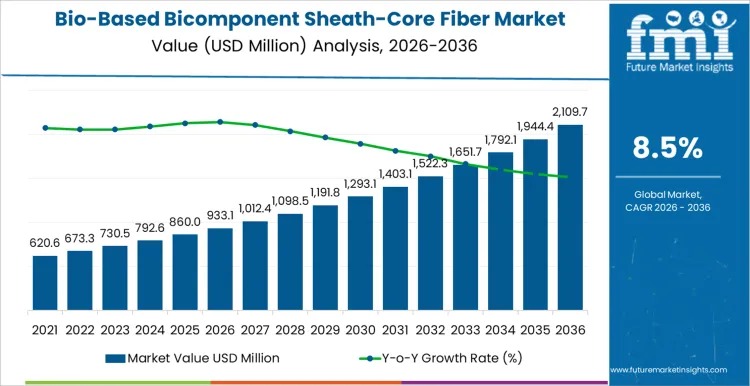
NEWARK, DE, UNITED STATES, January 20, 2026 /EINPresswire.com/ -- The global bio-based bicomponent sheath-core fiber market opens 2026 at USD 933.1 million and is projected to reach USD 2,109.7 million by 2036, expanding at a compound annual growth rate (CAGR) of 8.5%. Growth is shaped by long qualification cycles, strict specification control, and rising substitution of fossil-based binders across nonwovens, hygiene products, and technical textiles.
The market is defined by how fibers perform inside existing production systems. Engineers specify sheath chemistry, core stiffness, and draw ratios during early product development. Once approved, fiber architectures remain fixed for multi-year programs, making growth dependent on platform conversions rather than short-term purchasing shifts.
Market Context and Growth Drivers
Bio-based bicomponent sheath-core fibers are used to separate bonding behavior from structural strength within a single filament. This architecture allows converters to control bonding temperature, hand feel, and recyclability without redesigning fabric constructions. Demand expands as manufacturers replace fossil-based binders, increase thermal bonding capacity, and extend use into filtration, medical, insulation, and packaging substrates.
Revenue growth tracks the number of production lines converted to bio-based bonding solutions. Once a fiber grade is written into specifications, substitution is rare, reinforcing portfolio stability and predictable demand patterns.
Product Architecture and Qualification Control
Participation in this market depends on early involvement in development programs and retention within approved material lists. Acceptance requires documented evidence on peel strength, aging behavior, and downstream compatibility. Replacement typically occurs only during platform redesigns, not routine procurement cycles.
Supplier selection emphasizes:
• Consistency across production lots
• Documentation depth and audit readiness
• Proven performance within defined bonding windows
Key Market Metrics
• Market Value (2026): USD 933.1 million
• Forecast Value (2036): USD 2,109.7 million
• CAGR (2026–2036): 8.5%
• Leading Type: Bio-based sheath with fossil core
• Key Regions: China, USA, Germany, South Korea, Japan
Sheath-Core Combinations and Polymer Families
Bio-based sheath with fossil core accounts for roughly 30% of market share, as it enables surface-level sustainability claims while preserving familiar mechanical performance. Fully bio-based constructions face higher validation burdens, slowing adoption despite technical viability.
By polymer family, PLA and derivatives lead with about 36% share, supported by compatibility with existing spinning and bonding windows. Bio-polyesters, copolymers, and bio-polyamides serve applications requiring broader thermal tolerance or higher durability. Once embedded in contracts and labels, polymer family changes are infrequent due to requalification costs.
Regional Demand Patterns
China leads growth at 9.7% CAGR, driven by large-scale nonwoven production and rapid replication across plants. The USA (8.2%) and Germany (8.1%) show steady expansion tied to hygiene and technical textile specifications. South Korea (7.7%) and Japan (7.0%) reflect platform-driven and quality-focused adoption models.
Explore trends before investing – request a sample report today! https://www.futuremarketinsights.com/reports/sample/rep-gb-31593
Competitive Landscape
Key suppliers—including Far Eastern New Century, Indorama Ventures, Toray Industries, Teijin, NatureWorks (via partners), Sateri, Advansa, Kelheim Fibres, and Huvis—compete primarily on process stability, sheath-core ratio control, and certification support. Once qualified, suppliers retain positions through consistent thermal behavior, reliable lead times, and scalable production.
Key Players in Bio-Based Bicomponent Sheath-Core Fiber Market
• Far Eastern New Century
• Indorama Ventures
• Toray Industries
• Teijin
• NatureWorks (via partners)
• Sateri
• Advansa
• Kelheim Fibres
• Huvis
Browse Related Insights
Bio-based Aircraft Coatings Market: https://www.futuremarketinsights.com/reports/bio-based-aircraft-coatings-market
Bio-Based Polyester Precursors for High-Performance Bioplastics Market: https://www.futuremarketinsights.com/reports/bio-based-polyester-precursors-for-high-performance-bioplastics-market
Bio-Based Effect Pigments for Color Cosmetics Market: https://www.futuremarketinsights.com/reports/bio-based-effect-pigments-for-color-cosmetics-market
About Future Market Insights (FMI)
Future Market Insights, Inc. (FMI) is an ESOMAR-certified, ISO 9001:2015 market research and consulting organization, trusted by Fortune 500 clients and global enterprises. With operations in the U.S., UK, India, and Dubai, FMI delivers data-backed insights and strategic intelligence across 30+ industries and 1,200 markets worldwide.
Sudip Saha
Future Market Insights Inc.
+18455795705 ext.
email us here
Legal Disclaimer:
EIN Presswire provides this news content "as is" without warranty of any kind. We do not accept any responsibility or liability for the accuracy, content, images, videos, licenses, completeness, legality, or reliability of the information contained in this article. If you have any complaints or copyright issues related to this article, kindly contact the author above.
