

Cloud Telephony Service Market to Reach US$ 48.4 Billion by 2033, Growing at 8.8% CAGR Globally
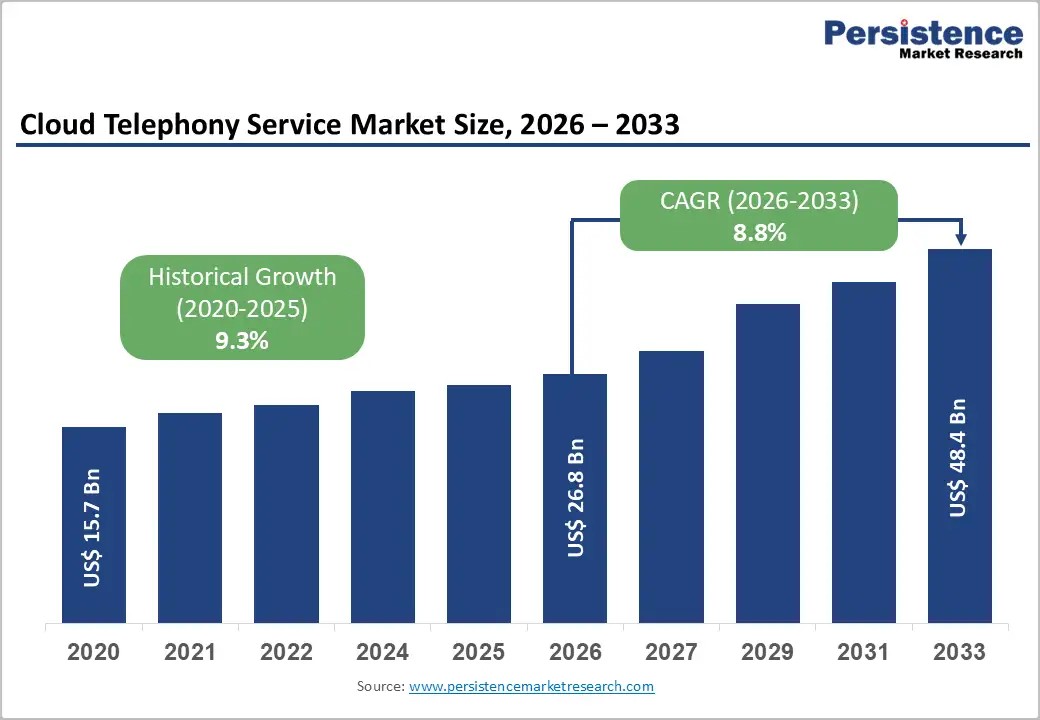
The global cloud telephony service market is set to grow from US$26.8 Bn in 2026 to US$48.4 Bn by 2033, registering a CAGR of 8.8%.
BRENTFORD, ENGLAND, UNITED KINGDOM, April 17, 2026 /EINPresswire.com/ -- The global cloud telephony service market is undergoing a significant transformation as enterprises rapidly move away from traditional PBX infrastructure toward cloud-based communication ecosystems. The market is projected to grow from US$ 26.8 billion in 2026 to US$ 48.4 billion by 2033, registering a steady CAGR of 8.8% during the forecast period. This growth is strongly supported by the global acceleration of digital transformation initiatives, the widespread adoption of Unified Communications as a Service (UCaaS) platforms, and the increasing normalization of remote and hybrid work environments. Organizations are prioritizing scalable, flexible, and cost-efficient communication systems, making cloud telephony a core component of modern enterprise IT infrastructure.
A key factor driving market expansion is the large-scale transition from legacy PBX systems to cloud-based unified communication solutions, which alone contributes significantly to overall CAGR growth. Enterprises are increasingly recognizing the value of eliminating hardware dependencies, reducing maintenance costs, and enabling seamless communication across distributed teams. Among all segments, UCaaS dominates the market with a 41.6% share, owing to its ability to integrate voice, video, messaging, and collaboration tools into a single platform. Regionally, North America leads the global market with a 41% share, driven by advanced cloud infrastructure, high enterprise IT spending, and strong adoption of hybrid work models. The region’s mature digital ecosystem and early technology adoption culture continue to reinforce its leadership position.
𝐆𝐞𝐭 𝐚 𝐒𝐚𝐦𝐩𝐥𝐞 𝐏𝐃𝐅 𝐁𝐫𝐨𝐜𝐡𝐮𝐫𝐞 𝐨𝐟 𝐭𝐡𝐞 𝐑𝐞𝐩𝐨𝐫𝐭: https://www.persistencemarketresearch.com/samples/34921
Market Segmentation
The cloud telephony service market is segmented based on service type, deployment model, organization size, and end-user industry, reflecting the varied communication needs of modern enterprises. By service type, it includes UCaaS, CPaaS, and CCaaS, where UCaaS leads due to its all-in-one communication features, while CPaaS is expanding rapidly with API-driven integrations in digital applications. CCaaS is also growing as businesses focus on improving customer support and contact center efficiency.
Based on deployment model, the market is divided into public, private, and hybrid cloud, with public cloud dominating due to its scalability, cost efficiency, and quick deployment advantages. Hybrid models are increasingly adopted by large enterprises that require a balance between data control and flexibility. By organization size, SMEs are the fastest-growing segment as they shift to subscription-based models that eliminate infrastructure costs and simplify operations.
In terms of end users, key industries include IT and telecom, BFSI, healthcare, retail, manufacturing, and government. IT and telecom lead due to high communication demand, while BFSI and healthcare are rapidly adopting cloud telephony for secure and compliant communication systems. Overall, each segment highlights the shift toward AI-enabled, cloud-native communication ecosystems.
Regional Insights
Regionally, North America dominates the cloud telephony service market with around 41% share, supported by strong cloud infrastructure, high IT spending, and widespread hybrid work adoption. The United States leads the region with strong UCaaS and CCaaS usage across industries such as finance, healthcare, and professional services.
Europe is a mature market driven by strict data privacy regulations like GDPR, which encourage secure and compliant cloud telephony solutions. Countries such as Germany, the UK, and France are steadily increasing adoption, often favoring hybrid deployment models due to data sovereignty concerns.
Asia Pacific is the fastest-growing region, projected to grow at a CAGR of 10.9%, driven by rapid digital transformation, expanding BPO industries, and smart city initiatives. India, China, and Japan are major contributors, while Southeast Asia is emerging with strong demand for cost-effective CPaaS and mobile-first communication solutions.
𝐃𝐨 𝐘𝐨𝐮 𝐇𝐚𝐯𝐞 𝐀𝐧𝐲 𝐐𝐮𝐞𝐫𝐲 𝐎𝐫 𝐒𝐩𝐞𝐜𝐢𝐟𝐢𝐜 𝐑𝐞𝐪𝐮𝐢𝐫𝐞𝐦𝐞𝐧𝐭? 𝐑𝐞𝐪𝐮𝐞𝐬𝐭 𝐂𝐮𝐬𝐭𝐨𝐦𝐢𝐳𝐚𝐭𝐢𝐨𝐧 𝐨𝐟 𝐑𝐞𝐩𝐨𝐫𝐭: https://www.persistencemarketresearch.com/request-customization/34921
Market Drivers
The cloud telephony service market is primarily driven by the rapid shift toward remote and hybrid work models, which has increased demand for flexible and location-independent communication systems. Enterprises are adopting cloud telephony to enable seamless collaboration across distributed teams while ensuring uninterrupted connectivity. Another key driver is the ongoing migration from legacy PBX systems to cloud-based UC platforms, as organizations seek to reduce high maintenance costs and improve scalability. Cloud solutions also lower total cost of ownership by over 30% and offer predictable subscription pricing, making them highly attractive for enterprises. In addition, the integration of AI-powered features like call analytics and automated routing is enhancing productivity and customer experience.
Market Restraints
Despite strong growth, the market faces challenges related to security, compliance, and data privacy. Cloud telephony systems must comply with strict regulations such as GDPR, HIPAA, and PCI-DSS, which increases deployment complexity. Vendor lock-in and interoperability issues also limit flexibility, as switching providers can be costly and technically challenging. In addition, inconsistent internet connectivity in developing regions restricts adoption, while hybrid cloud setups and data transfer costs further add to operational uncertainty for enterprises.
Market Opportunities
The market offers strong growth opportunities through AI-driven communication technologies, including real-time call analytics, sentiment analysis, predictive routing, and automated transcription, all of which improve efficiency and customer satisfaction. The rapid expansion of CPaaS is another major opportunity, as businesses embed communication APIs into applications for omnichannel engagement across retail, fintech, healthcare, and logistics sectors. Additionally, the rise of autonomous contact centers (CCaaS) is transforming customer service operations by reducing costs and improving first-call resolution through intelligent automation.
𝐁𝐮𝐲 𝐍𝐨𝐰 𝐭𝐡𝐞 𝐃𝐞𝐭𝐚𝐢𝐥𝐞𝐝 𝐑𝐞𝐩𝐨𝐫𝐭: https://www.persistencemarketresearch.com/checkout/34921
Company Insights: Key Players in the Cloud Telephony Service Market
• RingCentral
• Twilio
• Vonage
• 8x8 Inc.
• Cisco Systems
• Microsoft Corporation (Teams Phone)
• Zoom Video Communications
• Tata Communications
• Vodafone Group
• Airtel (Bharti Airtel / Xtelify)
Conclusion
The cloud telephony service market is entering a transformative growth phase driven by hybrid work adoption, rapid enterprise digitization, and the shift from legacy telephony systems to scalable cloud-native communication platforms. With strong momentum across UCaaS, CPaaS, and AI-enabled contact center solutions, the industry is evolving beyond traditional voice communication into a fully integrated digital engagement ecosystem. As enterprises prioritize operational efficiency, cost optimization, and customer experience enhancement, cloud telephony is expected to become a foundational pillar of global business communication infrastructure through 2033 and beyond.
Related Reports:
Bulk Acoustic Wave (BAW) Filters Market
Pooja Gawai
Persistence Market Research
+1 646-878-6329
email us here
Visit us on social media:
LinkedIn
Instagram
Facebook
YouTube
Legal Disclaimer:
EIN Presswire provides this news content "as is" without warranty of any kind. We do not accept any responsibility or liability for the accuracy, content, images, videos, licenses, completeness, legality, or reliability of the information contained in this article. If you have any complaints or copyright issues related to this article, kindly contact the author above.
