

At U.N. Youth Forum Side Event, Speakers Urge Trusted Data and Responsible AI for Verifiable ESG Delivery

Mario Baez — former chief of the Accountability Service at the United Nations Secretariat

Barry Katz — Stanford professor and IDEO fellow
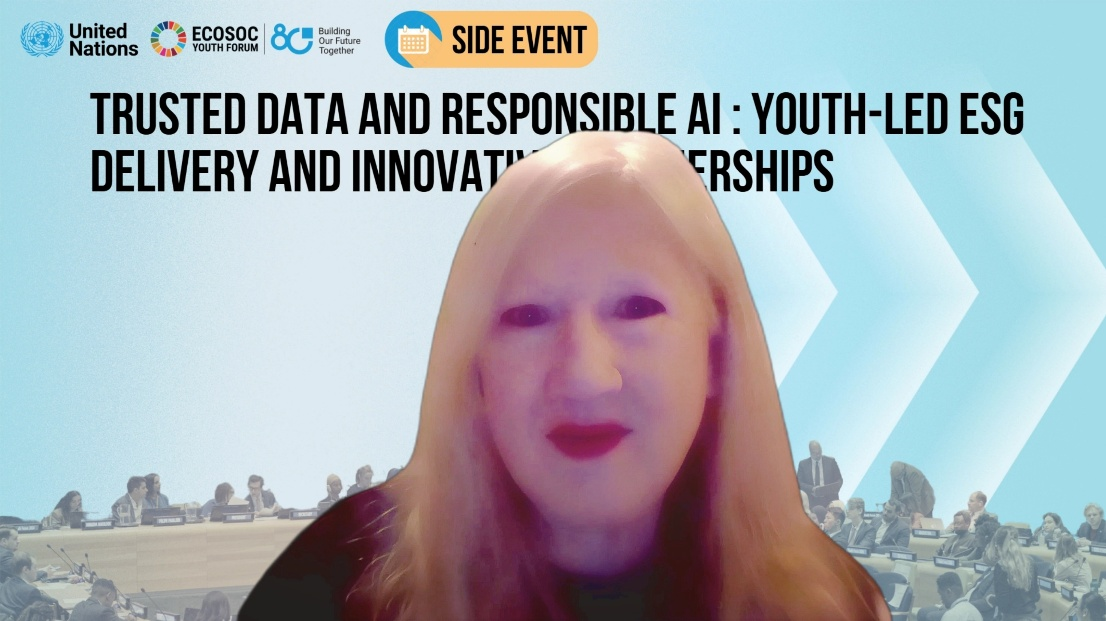
Margaret Harris — former WHO spokesperson
Participants included experts from the United Nations, the World Health Organization and Stanford University, alongside youth representatives from Columbia University, Tsinghua University and Shanghai Starriver Bilingual School. The session was moderated by Wang Muyao, Part-Time Associate Faculty in the Enterprise Risk Management Program at Columbia University.
In opening remarks, Xing Tang, executive dean of the Grouphorse ESG Global Governance Talent Industrial College and founder of Grouphorse Group, framed the discussion around a central question: how to move “from commitment to delivery.” Recalling his presence at U.N. Headquarters when the 2024 Summit of the Future adopted the Pact for the Future and the Global Digital Compact, Tang said digital technology is no longer merely a tool for efficiency but an increasingly important force shaping trust, fairness and the quality of development. He described trusted data as the foundation of public trust and effective delivery, called responsible AI an essential governance precondition in the digital age, and argued that youth must grow from issue participants into deliverers of outcomes. The central challenge, he said, is how to turn passion into evidence, initiatives into results and fragmented actions into sustainable, verifiable mechanisms for cooperation.
Mario Baez, who served as chief of the Accountability Service at the United Nations Secretariat from January 2019 to May 2024, said global governance is shifting from backward-looking compliance toward what he called “verifiable delivery.” He argued that many youth projects struggle because they remain trapped in “black box” systems in which data is fragmented, processes are opaque and outcomes cannot be audited or scaled. Baez said trusted data should be treated as a new development foundation and that AI must operate within responsible governance frameworks, allowing youth-led projects to become replicable public-governance models rather than one-off initiatives. He also called for long-term co-creation mechanisms linking universities, technology platforms and civil society groups.
Barry Katz, a Stanford professor and IDEO fellow, argued that design should be understood not as the making of attractive new objects but as a strategy for solving real problems. He illustrated that point with a Stanford student team’s work on a low-cost infant warming device for premature babies in low-resource settings. Rather than simply redesigning an incubator, the students identified the challenge as keeping newborns warm for hours in villages with little electricity and limited medical access. Through field research in Nepal, repeated prototyping and cultural adaptation, the team developed a low-cost solution that could function without power and later scale globally. Katz said effective design must be rooted in field realities, repeated testing and cultural understanding, and ultimately must leave the classroom and enter the world as a verifiable and repeatable delivery system.
Margaret Harris, a former WHO spokesperson, focused on the role of communication in building trust. She said even strong ideas and technically sound projects will fail if the intended public does not trust them. Drawing on her experience in public health risk communication, Harris said trust depends on listening rather than one-way messaging, coordinating across platforms and institutions, acknowledging uncertainty and linking communication to services people can actually access. She argued that evidence only leads to action when communication, community understanding and usable services form a closed loop.
A youth project showcase featured 12 presenters whose proposals ranged across education, public health, environmental monitoring, agriculture, urban safety and AI governance. Deng Zhuoyao, an incoming M.S. student in Applied Analytics at Columbia University, warned that cross-border AI systems can worsen harms related to youth mental health when data rights, consent and accountability are weak. Tsinghua University graduate student Zhang Yue, drawing on work with the U.N. Food and Agriculture Organization, described how AI-enabled knowledge systems can turn fragmented agrifood data into structured evidence for policy and practice.
Students from Shanghai Starriver Bilingual School then presented projects on industrial scheduling, fair AI in education, rural education inequality, antimicrobial resistance, water monitoring, agricultural fertilizer technology, airport wildlife safety, AI for health equity, veterinary antibiotic monitoring and AI-assisted memory therapy for dementia care. Minghao Shi proposed open-source industrial scheduling tools for small manufacturers. Yanming Huang called for mandatory fairness audits for AI education systems. Ranze Xiao urged multilateral financing for digital education infrastructure. Zimeng Wang pressed for stronger global reporting rules on veterinary antibiotic use. Runchen Sha presented a decentralized water-quality monitoring network. Jiahong Ren proposed youth agricultural innovation funds tied to controlled-release fertilizer technology. Chenyang Qu called for machine-readable bird-strike data standards for aviation safety. Chengen Li argued for federated health-data sharing to support fairer AI in medicine. Han Xia proposed blockchain-backed livestock certification tied to antimicrobial-resistance compliance. Xiang Ma called for international standards governing sensitive memory data in AI health applications. Their proposals reflected a broader push to make youth-led innovation auditable, scalable and policy relevant.
In closing remarks, U.N. project design consultant Yujie Chen said the next step is to turn the side event from a one-time exchange into a sustainable delivery network linking universities, technology platforms and nongovernmental organizations. Across the session, speakers returned to a common conclusion: in the AI era, youth participation in global governance depends not only on raising issues, but on building auditable evidence chains, reproducible delivery paths and cross-sector partnerships that can scale.
XING TANG
Grouphorse Group
email us here
Legal Disclaimer:
EIN Presswire provides this news content "as is" without warranty of any kind. We do not accept any responsibility or liability for the accuracy, content, images, videos, licenses, completeness, legality, or reliability of the information contained in this article. If you have any complaints or copyright issues related to this article, kindly contact the author above.
