

"Vertical Is the Future of Outdoor Advertising, Says Sky Blue Group Chairman"
Our industry spent decades perfecting the horizontal canvas. The audience has moved on. It is time we do too.
Dubai, UNITED ARAB EMIRATES, July 07, 2026 (GLOBE NEWSWIRE) -- Dato' Manikandamurthy Velayoudam, Chairman of Sky Blue Group, is calling for greater adoption of vertical digital out-of-home advertising across SkyBlue Out-of-Home Media operations in UAE and the Malaysia. SkyBlue Media UAE, the advertising arm of SkyBlue Group and exclusive OOH and transit advertising partner for Dubai's RTA, has positioned vertical formats as aligned with portrait-first mobile viewing behavior, with Dato' Manikandamurthy Velayoudam citing data showing that 81% of Gen Z video viewers watch vertical video every week. He pointed to elevator screens, vertical unipoles, minipoles, mall pillars, transit platforms, and freestanding kiosks as formats positioned for growth across Asia and MENA. He added that the UAE DOOH market is projected to grow at 16.4% CAGR through 2030, creating an opportunity for media owners and advertisers to define the region's next visual standard.
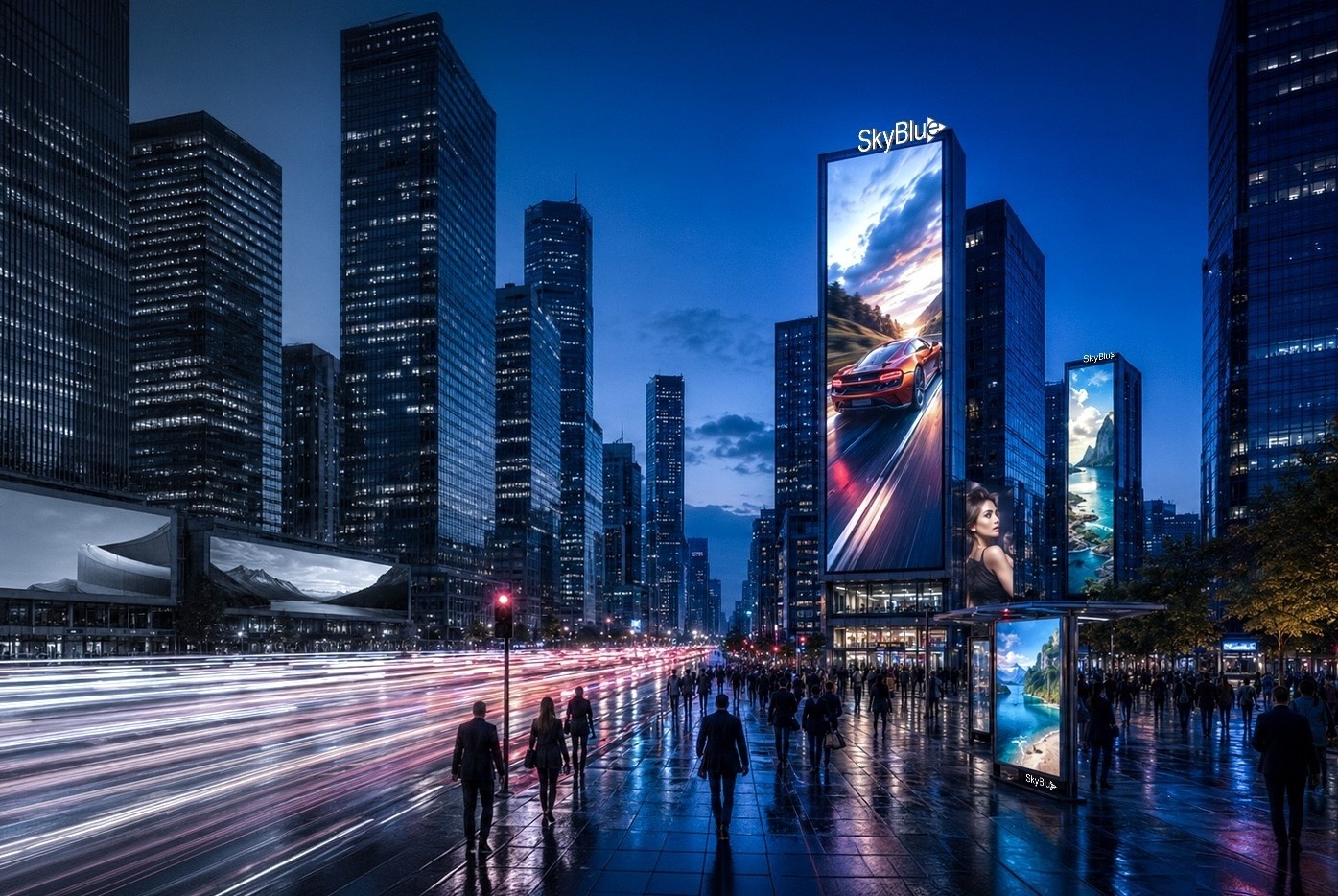
The World Has Turned Vertical- Dato Manikandamurthy Velayoudam - Sky Blue Media UAE
01 · THE PSYCHOPHYSIOLOGY OF THE SCROLL
The Brain Has Already Gone Vertical
Cognitive adaptation to technology happens faster than most industries are comfortable admitting. A generation raised on portrait first devices doesn't merely prefer vertical content; they experience horizontal formats as friction. The widescreen rectangle, the very shape that television trained the 20th century to expect, now feels effortful to the 21st-century eye. It requires a micro-moment of reorientation that the younger brain has simply stopped offering by default.
This is not guesswork. Research surveying 2,000 Gen Z respondents found that 81% of Gen Z video viewers watch video in vertical format every week not as an occasional alternative, but as their primary, instinctive behaviour. Platforms have responded in kind: vertical videos on major short-form video platforms now achieve a 90% higher watch-completion rate than horizontal equivalents. The audience is not just choosing portraits. They are finishing what they start in portrait.
\"The screen that fits how people actually hold things has won. We didn't choose vertical. Vertical chose us one thumb scroll at a time.\"
Neurologically, the human field of comfortable vision in close proximity contexts, the distance at which we hold a phone, is naturally suited to vertical scanning. What began as a technical accident of early smartphone design has, over fifteen years of daily reinforcement, become a deeply embedded cognitive norm. Billions of repetitions a day have done what no marketing campaign ever could: rewired the default orientation of human visual attention.
Key Statistics:
- 3.2 hours Gen Z average daily social media time, more than double Baby Boomers at 1.5 hours
- 81% of Gen Z watch video in vertical format every week as their primary viewing behaviour
- 89 minutes per day average time Gen Z aged 13–24 spend on a single vertical only platform
- 90% higher watch completion rate for vertical video content over horizontal equivalents
02 · BORN VERTICAL
The First Generation That Never Held a Camera Sideways
Generation Z numbers approximately 2 billion people globally roughly 26% of the world's population. They did not transition to smartphones as adults. They arrived into a world where the phone was already the primary screen, the primary camera, the primary window to commerce, culture, and connection. Their first videos were shot in portrait. Their first platforms were portraits. Their first advertising encounter was a portrait.
Nearly 99% of this generation own or have access to a smartphone. On the platform level, the data is unambiguous: daily usage rates across major short-form video and social platforms range from 56% to 63%, platforms that have collectively made vertical the dominant content grammar of our time. On a single vertical-first platform, users aged 13 to 24 spend an average of 89 minutes per day. That is nearly an hour and a half, every single day, consuming content in portrait orientation, from a device held in one hand.
By 2030, Gen Z's global spending power is projected to reach $12 trillion. They will be the defining consumer class within this decade. Any media format that does not speak their visual language that requires even a moment of reorientation is not simply underperforming. It is becoming inaudible.
"A generation that discovers what to watch through a portrait format clip is being served outdoor advertising designed for people who discovered it on television. That is the gap our industry must confront honestly, and urgently."
Key Statistics:
- 56% of Gen Z adults use a major vertical-first platform daily
- ~2 billion people Gen Z global population, 26% of humanity, every one of them mobile-first from birth
- $12 trillion Gen Z projected global spending power by 2030
- 2 hours 40 minutes global average daily social media usage, almost entirely in portrait on mobile
03 · EVEN HOLLYWOOD IS BOWING
When Streaming Giants Shoot Horizontally and Edit Vertically, Something Fundamental Has Shifted
Consider what is happening to an industry built entirely on the horizontal frame. The world's largest streaming platforms now produce vertical cuts of their premium content as standard practice not as a creative experiment, but as a commercial necessity. If a trailer does not work in portrait, it will not spread on social media. And if it does not spread on social media, it will not reach the audience that decides what to watch next.
Research confirms what instinct already suspects: 63% of viewers under 35 say they discovered a show because they saw a clip of it on a social platform. Those clips were vertical. The recommendation happened in portrait. The audience converted and then went to a widescreen streaming service to watch the full programme. Even television, the original champion of the horizontal rectangle, now relies on a vertical funnel to fill its audience.
Short form video consumption has grown more than 75% globally since the early 2020s. Korean and Turkish drama producers whose content dominates streaming charts across MENA now plan their shoots with simultaneous vertical framing as a primary consideration, not an afterthought. When storytellers adapt at the production level, advertisers have no logical reason to remain behind.
THE VERTICAL CANVAS FORMAT BY FORMAT
Every Surface Is a Portrait. The Question Is Who Gets There First.
From lift lobbies to highway unipoles the vertical screen meets audiences in the exact orientation their eyes have been trained to receive. These are the formats leading the shift across Asia and positioning themselves across MENA.
- Lift / Elevator Screen Captive, High Recall Environment: 30 seconds of undivided attention, every floor. The enclosed space with no exit ensures genuine, unavoidable engagement.
- Vertical Unipole Highways & Major Road Corridors: The 9:16 ratio reimagined at scale. Portrait format on major arterials delivers the smartphone visual grammar at billboard impact.
- Minipole / Lamppost Community Streets & Retail Zones: Brand presence at walking pace, portrait format. Close proximity, pedestrian level engagement in residential and retail neighbourhoods.
- Mall Pillar / Totem High Dwell Retail Environments: Dynamic content meets the shopping moment. QR enabled vertical screens at point of consideration to drive immediate interaction.
- Transit / Metro Platform Contextual Vertical Display: Live, time-sensitive, contextual. Portrait screens on transit platforms serve audiences with both attention and intent.
- Freestanding Totem Point of Intent, Retail & Commercial: Where intent meets the brand. Vertical format at the exact moment of consumer decision making.
04 · THE EAST HAS ALREADY MOVED
From Shanghai to Seoul, Vertical Is Infrastructure. MENA, Your Turn.
I have watched this transformation unfold across Asia with great attention, and what strikes me most is not the scale of the shift; it is how quietly and completely it happened. Across China, vertical screens in lift lobbies and elevator corridors have become so embedded in the advertising ecosystem that they are no longer considered innovative. They are simply how urban advertising works. Cities across South Korea and Japan have systematically retrofitted transit networks with portrait format panels. Across Singapore, Indonesia, and Malaysia, the vertical screen has moved from novelty to norm in less than a decade.
The performance data from these markets is compelling. Vertical DOOH screens in captive, close-proximity environments, including lift lobbies, elevator interiors, and transit platforms consistently deliver 70% brand recall rates, compared to the 30–60% typical of general outdoor formats. They achieve more than four times the recall of standard digital display advertising. The enclosed, distraction-free environment does what no algorithm can: it commands genuine, undivided attention in a format the viewer's brain is already primed to process.
What Asia has demonstrated is not just a format preference; it is a business model. Vertical screens at pedestrian eye level, in the spaces people inhabit daily, produce measurable outcomes that horizontal highway billboards simply cannot replicate at equivalent cost. The industry in the East understood this early. The question for the Middle East is how much longer it intends to wait.
East Asia — Already Transformed:
- Lift and elevator advertising now standard urban infrastructure in major cities across China, Korea, Japan, and Southeast Asia
- Transit networks across South Korea and Japan systematically converting to portrait format LED panels
- Singapore: 32% of elevator campaigns in 2024 integrated mobile QR and NFC interaction
- India: metro-rail vertical screen digitisation actively underway across Delhi, Mumbai, and Bangalore
- Unipoles, minipoles, and lamppost formats in vertical orientation now dominant in major East Asian urban corridors
UAE & MENA — The Open Window:
- UAE DOOH market growing at 16.4% CAGR fastest in the entire MENA region through 2030
- Elevator screen networks across Dubai and Abu Dhabi expanding rapidly, predominantly still horizontal
- Unipoles along Sheikh Zayed Road and major arterials still overwhelmingly landscape format
- Lamppost and minipole infrastructure across UAE ready for vertical conversion
- UAE smartphone penetration ~99% the audience is already vertical; the screens have not caught up
- First mover advantage in vertical DOOH at scale across MENA remains unclaimed
The UAE DOOH market is projected to grow at 16.4% CAGR through 2030, the fastest expansion rate in MENA. That growth will be shaped by the decisions made in the next two to three years. The media owners and advertisers who define the visual language of this next chapter will not simply be early adopters. They will be the standard that everyone else follows.
05 · A CALL TO THE INDUSTRY
The Horizontal Billboard Had Its Century. This One Belongs to Portrait.
I want to be direct with the industry I have been part of for many years, and which I operate within across Malaysia and the UAE. The horizontal billboard made perfect sense in a world defined by horizontal media. The television was horizontal. The cinema was horizontal. The newspaper was wider than it was tall. Every visual reference point confirmed that landscape was the natural shape of communication. That world no longer exists.
Today, the average person encounters an estimated 6,000 to 10,000 advertising messages every day. In that environment of extraordinary saturation, format coherence matters enormously. A vertical screen delivers a message in the same orientation the viewer's visual cortex has spent the last several hours processing. There is no reorientation. No friction. The message arrives the way the brain is already set to receive it. That is a creative and commercial advantage we are leaving on the table every time we serve a horizontal creative to a portrait trained eye.
There is also a straightforward structural case. Vertical screens maximise visual surface at pedestrian eye level without requiring a wider physical footprint. In markets like Dubai and Kuala Lumpur, where prime advertising locations command some of the highest costs in the world, that geometry matters. More impact per square metre. More relevance per impression. Better returns for media owners, better outcomes for advertisers, and a better experience for an audience that has already voted conclusively, with billions of daily scrolls for portrait.
"The question is not whether vertical DOOH will arrive in UAE and MENA. It is whether our industry will have the courage to lead that arrival or wait to be led by markets that moved while we deliberated."
At SkyBlue Out-of-Home Media, we are already making that commitment across our operations in Malaysia and the UAE. Not because the data demands it, though it does, unambiguously, but because spending time in this industry teaches you to read direction before it becomes a rearview mirror. The consumer has turned vertical. The content has turned vertical. The technology is ready. The only thing left is the decision.
I believe the UAE, with its world-class infrastructure, its ambition, and its history of being the region that sets the pace rather than follows it, is exactly the right market to lead this transformation across MENA. The screens are already here. The audience is already here. The moment is now.
Key Statistics:
- 70% brand recall vertical, captive environment DOOH vs. 30–60% for general outdoor formats
- 16.4% CAGR to 2030 UAE DOOH market growth rate, fastest in MENA
- 73% of consumers view DOOH ads favourably ahead of TV at 50% and social media at 48%
- ~99% smartphone penetration in UAE the audience is vertical; the outdoor canvas hasn't followed yet
About the Author
Dato' Manikandamurthy Velayoudam is the Chairman of Sky Blue Group, a multi-vertical media and entertainment conglomerate with operations across the USA, South Korea, Malaysia, India, UAE, Turkey, and Nigeria. The Group's verticals include Sky Blue Media (Out-of-Home and Digital Out-of-Home advertising in Malaysia and the UAE), Sky Blue Cinematix (Film Brand Integrators), and investments across media, mobility, and entertainment. Dato' Manikandamurthy Velayoudam writes on media strategy, the future of advertising, and the business of storytelling across emerging and frontier markets.
Statistical data sourced from third-party industry research
About Sky Blue Media UAE
SkyBlue Media UAE is a premier OOH and transit advertising powerhouse and the exclusive partner for Dubai’s RTA, turning public buses, mupis, and shelters into high-visibility brand campaigns.
Press Inquiries
Dato Manikandamurthy Velayoudam
mani [at] skybluegroup.com
800 7592
https://skybluemedia.ae/
Unit 23 & 24 – Costra Business Park,
Block D, Dubai Production City,
Dubai, UAE. PO Box # 30620


Legal Disclaimer:
EIN Presswire provides this news content "as is" without warranty of any kind. We do not accept any responsibility or liability for the accuracy, content, images, videos, licenses, completeness, legality, or reliability of the information contained in this article. If you have any complaints or copyright issues related to this article, kindly contact the author above.
