

Clean Label Ingredients Market to Reach USD 92.95 Billion by 2035 on Transparent Food Demand
Clean Label Ingredients Market
Market Research Future Report Highlights Fastest Growth in Food Colorants and Europe as Demand Accelerates Across Food and Beverage Applications
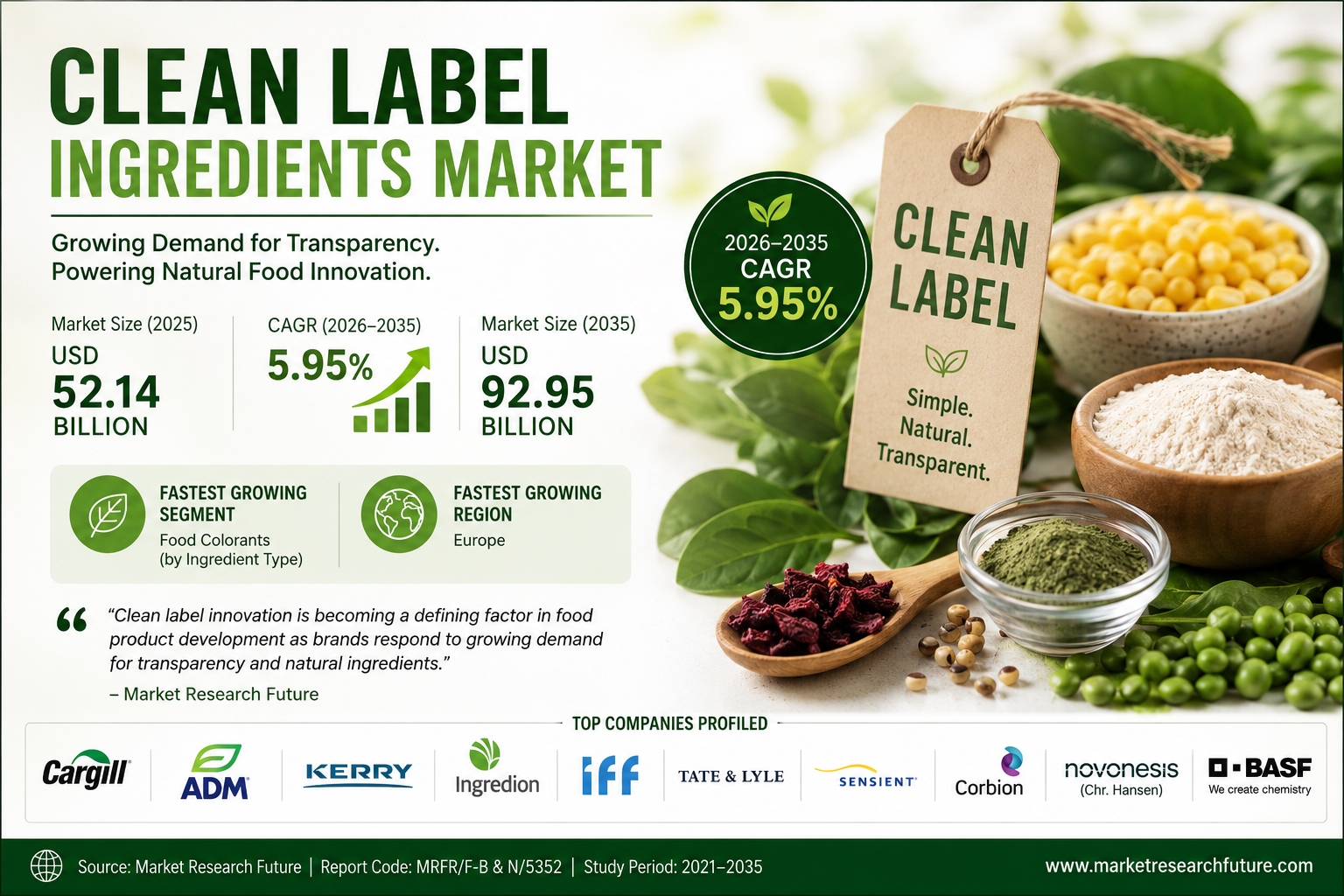
Clean label innovation is becoming a defining factor in food product development as brands respond to growing demand for transparency and natural ingredients.”
NEW YORK, NY, UNITED STATES, July 10, 2026 /EINPresswire.com/ -- The global Clean Label Ingredients Market is entering a sustained growth phase as food and beverage manufacturers accelerate reformulation strategies to meet rising consumer expectations for transparency, simplicity, and recognizable ingredient lists. According to the Market Research Future latest market outlook, the market is valued at USD 52.14 billion in 2025 and is projected to reach USD 92.95 billion by 2035, expanding at a CAGR of 5.95% during the forecast period from 2026 to 2035. Over the full forecast horizon, the market is expected to add USD 40.81 billion in incremental value, underscoring the scale of opportunity for ingredient suppliers and food manufacturers alike.— Market Research Future (MRFR)
Market Overview
The shift toward clean label products is no longer limited to a niche consumer preference. It has become a central product development priority for major food, beverage, and ingredient companies worldwide. Growing scrutiny of ingredient statements, increasing awareness of food processing methods, and wider demand for natural, minimally processed, and easy-to-understand formulations are all contributing to the category’s momentum. As a result, clean label ingredients are increasingly being adopted across bakery, dairy, confectionery, sauces, snacks, ready meals, beverages, and nutraceutical applications.
The market scope covers global ingredient supply for food and beverage applications, reflecting the broad role clean label solutions now play in modern formulation strategies. The study period spans 2021 to 2035, with the forecast period running from 2026 to 2035. During this time, manufacturers are expected to continue replacing synthetic additives and artificial ingredients with naturally derived alternatives that support both product performance and consumer trust.
Clean label ingredients are commonly used to replace synthetic additives, chemical preservatives, artificial colors, modified starches, and other ingredients that consumers may perceive as overly processed. In many cases, they help manufacturers preserve product quality while maintaining the appearance of a simpler label. These ingredients include natural preservatives, plant-based colorants, natural texturizers, starches, enzymes, hydrocolloids, acidulants, fibers, and other functional solutions that support shelf stability, taste, texture, and visual appeal.
Get Full PDF Sample Copy of Report: (Including Full TOC, List of Tables & Figures, Chart) @ https://www.marketresearchfuture.com/sample_request/5352
Consumer Demand and Label Transparency
One of the strongest growth drivers in the market is consumer demand for transparency. Today’s shoppers are more likely to read ingredient labels and compare products across brands. This behavior is influencing purchasing decisions across supermarkets, convenience stores, online channels, and specialty health-focused retail formats. Food companies are responding by reformulating products to remove ingredients that are hard to pronounce, synthetic-sounding, or inconsistent with “natural” positioning. This trend is especially visible in categories where ingredient lists are highly visible to consumers, such as snacks, beverages, dairy alternatives, baked goods, and sauces.
The market is also benefiting from the broader expansion of health-conscious consumption. Consumers are increasingly associating clean label products with better quality, reduced processing, and a healthier lifestyle. Although clean label does not always mean organic, non-GMO, vegan, or allergen-free, these claims often overlap and reinforce one another in the marketplace. Brands that can credibly communicate ingredient simplicity, source transparency, and formulation integrity are better positioned to win trust and loyalty in competitive categories.
This shift is particularly important in premium and mainstream packaged food segments, where consumers are willing to pay more for products that align with their values. Clean label positioning is increasingly being used not only as a product attribute but also as a brand differentiator. For manufacturers, this means ingredient decisions are now closely tied to marketing strategy, retail performance, and long-term brand equity.
Application Trends Across Food and Beverage Categories
Food manufacturers continue to face a complex balancing act between consumer expectations and technical performance. Removing artificial ingredients can affect flavor, texture, color, mouthfeel, and shelf life. This has created strong demand for ingredient systems that perform multiple functions while maintaining a natural or familiar profile. Suppliers that can provide integrated solutions rather than isolated ingredients are gaining traction, especially among companies that need scalable reformulation support across multiple product lines.
Bakery remains one of the most important application areas for clean label ingredients. Bread, cakes, pastries, and other baked goods often require emulsifiers, preservatives, enzymes, and texturizers to maintain freshness and consistency. Clean label reformulation in this segment is driving demand for natural dough conditioners, enzyme systems, and plant-based stabilizers that can extend shelf life without compromising texture or taste.
In beverages, clean label ingredients are being used to replace artificial colors, synthetic sweeteners, and chemical stabilizers. Consumers increasingly expect beverages to look and taste natural, which has accelerated the adoption of fruit- and vegetable-based color systems, botanical extracts, and naturally derived flavor solutions. This is especially relevant in juices, flavored waters, functional drinks, and ready-to-drink products.
Dairy and dairy alternatives are also seeing strong clean label adoption. Manufacturers in this segment are seeking ingredients that can improve mouthfeel, stability, and consistency while supporting simpler labels. Natural thickeners, fibers, starches, and fermentation-derived ingredients are becoming more common in yogurts, desserts, plant-based milks, and cheese alternatives. In confectionery and snacks, clean label ingredients are helping brands maintain color vibrancy, texture, and shelf appeal while reducing reliance on synthetic additives.
Ingredient Type Outlook
Among ingredient types, food colorants are expected to be the fastest-growing segment over the forecast period. Demand for natural colorants is increasing as brands move away from synthetic dyes and seek more plant-derived alternatives. Bright, stable, and application-friendly natural colors are now being used in beverages, confectionery, dairy products, bakery items, and savory foods. As consumers continue to favor visible natural cues on packaging and in ingredient statements, natural color solutions are likely to remain one of the most dynamic segments within the market.
Beyond colorants, natural preservatives are gaining importance as manufacturers look for ways to extend shelf life without using artificial chemicals. Plant extracts, fermentation-based solutions, and naturally derived antimicrobial systems are being incorporated into a growing number of formulations. These ingredients are particularly valuable in refrigerated foods, sauces, dressings, and ready meals, where freshness and safety are critical.
Starches, fibers, hydrocolloids, and enzymes are also central to clean label innovation. These ingredients help improve viscosity, texture, moisture retention, and product stability while supporting simpler formulations. As food companies continue to reformulate at scale, multifunctional ingredients that can replace several conventional additives at once are becoming increasingly attractive.
Regional Outlook
Geographically, Europe is projected to be the fastest-growing region in the clean label ingredients market. This growth is supported by strong consumer interest in ingredient transparency, a mature regulatory environment, and a food industry that has been actively reformulating for years. European consumers are highly attentive to product composition, source quality, and sustainability claims, which has made clean label positioning especially important. The region’s food and beverage manufacturers are also increasingly investing in cleaner formulations to remain competitive across domestic and export markets.
North America continues to represent a major market for clean label ingredients, driven by strong demand for packaged foods that communicate simplicity and quality. Retailers and brands in the region are under pressure to deliver products with shorter ingredient lists and stronger natural positioning, particularly in categories such as snacks, beverages, bakery, and dairy. The region also benefits from a highly developed ingredient innovation ecosystem, which supports rapid commercialization of new clean label solutions.
At the same time, Asia-Pacific is becoming an increasingly important growth region as urbanization, rising disposable income, and changing dietary patterns accelerate demand for packaged and processed foods with better ingredient transparency. Consumers in the region are becoming more aware of ingredient quality and product origin, creating new opportunities for both multinational and regional ingredient suppliers. Latin America and the Middle East & Africa are also expected to present opportunities as global brands expand their clean label portfolios across emerging markets.
Competitive Landscape
The competitive landscape is shaped by a mix of global ingredient leaders and specialized solution providers. Companies profiled in the market include Cargill, ADM, Kerry Group, Ingredion, IFF, Tate & Lyle, Sensient, Corbion, Chr. Hansen/Novonesis, and BASF. These organizations are actively investing in product innovation, application support, sourcing capabilities, and natural ingredient technologies to help food manufacturers meet reformulation goals. Strategic product launches, portfolio expansion, and customer collaboration are increasingly central to market competition.
Large ingredient suppliers are focusing on multifunctional ingredients that help simplify label statements without sacrificing performance. This includes natural starches and fibers, fermentation-derived solutions, plant-based emulsifiers, natural preservatives, and color systems derived from fruit, vegetable, and botanical sources. As clean label expectations evolve, companies that can prove efficacy across a wide range of applications are likely to gain a stronger market position.
The market is also seeing increased collaboration between ingredient suppliers and food manufacturers at the development stage. Rather than waiting until late in the product cycle, brands are working earlier with suppliers to identify clean label solutions that can meet technical, sensory, and regulatory requirements simultaneously. This collaborative model is helping accelerate innovation and reduce the time needed to bring reformulated products to market.
Innovation and Sustainability
Another important trend shaping the market is the growing emphasis on sustainability and responsible sourcing. For many food companies, clean label is now intertwined with broader corporate sustainability goals. Brands want ingredients that are traceable, responsibly sourced, and aligned with environmental commitments. This is encouraging suppliers to improve supply chain visibility, invest in agricultural partnerships, and develop ingredients with lower environmental footprints where possible. In parallel, consumers are increasingly interpreting clean label as part of a wider trust equation that includes origin, production practices, and corporate values.
Technological innovation is also accelerating the development of clean label ingredient solutions. Advances in extraction, fermentation, enzyme processing, and formulation science are helping manufacturers achieve functionality that was previously difficult to replicate with naturally derived ingredients. These innovations are making it easier to substitute synthetic additives while preserving desirable product characteristics. As a result, the category is moving beyond simple ingredient removal and toward more sophisticated clean label design.
Fermentation-based ingredients, precision processing, and botanical extraction technologies are opening new possibilities for natural preservation, color stability, and texture enhancement. These advances are especially important for manufacturers that need to maintain product consistency across large-scale production environments. As innovation continues, clean label ingredients are expected to become more versatile, more cost-effective, and more widely adopted across mainstream food categories.
Market Challenges and Opportunities
The clean label trend is especially pronounced in product categories that depend heavily on sensory quality. In bakery applications, for example, manufacturers must manage texture, freshness, and shelf life while reducing unfamiliar ingredients. In beverages, they must balance color stability, flavor clarity, and visual appeal. In dairy and dairy alternatives, they must preserve mouthfeel and consistency while supporting cleaner statements. This technical complexity is one reason the market continues to attract investment from both ingredient suppliers and food manufacturers.
Despite strong growth prospects, the market still faces challenges related to cost, formulation complexity, and supply chain consistency. Natural and clean label ingredients can sometimes be more expensive or technically demanding than conventional alternatives, particularly when manufacturers need to maintain the same shelf life or sensory profile. However, many companies are increasingly willing to absorb these challenges in exchange for stronger consumer appeal, premium pricing opportunities, and improved brand reputation.
Private label and store-brand products are also contributing to market growth. Retailers are increasingly using clean label positioning to differentiate their offerings and strengthen consumer trust. As private label ranges expand across premium, health-focused, and convenience-driven segments, ingredient suppliers are seeing more demand for solutions that are cost-effective, scalable, and easy to integrate into large production systems.
Future Outlook
The market outlook remains positive despite ongoing formulation challenges and cost pressures. Natural and clean label ingredients can sometimes be more expensive or technically demanding than conventional alternatives, but manufacturers are increasingly willing to absorb those complexities in exchange for stronger consumer appeal. In many cases, clean label reformulation also supports premium pricing, improved brand reputation, and greater alignment with long-term market trends.
As the market moves toward 2035, clean label ingredients are expected to play an even larger role in product innovation, especially as food and beverage brands seek to deliver formulations that are both functional and familiar. The companies that succeed will likely be those that combine technical expertise, application support, and a strong understanding of evolving consumer expectations.
The projected growth of the global Clean Label Ingredients Market reflects more than a passing trend. It signals a structural shift in how food is made, marketed, and evaluated. Ingredient transparency, minimal processing, and natural positioning are becoming core elements of modern food strategy. For suppliers, manufacturers, and retailers alike, clean label ingredients are poised to remain a key area of investment and innovation throughout the next decade.
Discover Related Research Reports By Market Research Future:
Private Label Food and Beverage Market
https://www.marketresearchfuture.com/reports/private-label-food-and-beverage-market-23499
Protein Ingredients Market
https://www.marketresearchfuture.com/reports/protein-ingredients-market-1244
Cocoa Ingredients Market
https://www.marketresearchfuture.com/reports/cocoa-ingredients-market-1380
Sagar Kadam
Market Research Future
+1 628-258-0071
email us here
Legal Disclaimer:
EIN Presswire provides this news content "as is" without warranty of any kind. We do not accept any responsibility or liability for the accuracy, content, images, videos, licenses, completeness, legality, or reliability of the information contained in this article. If you have any complaints or copyright issues related to this article, kindly contact the author above.
