

Recall’s 2026 Second Brain Report Finds Retrieval of Saved Knowledge Rose 3x as Chat Became the Main Way Back
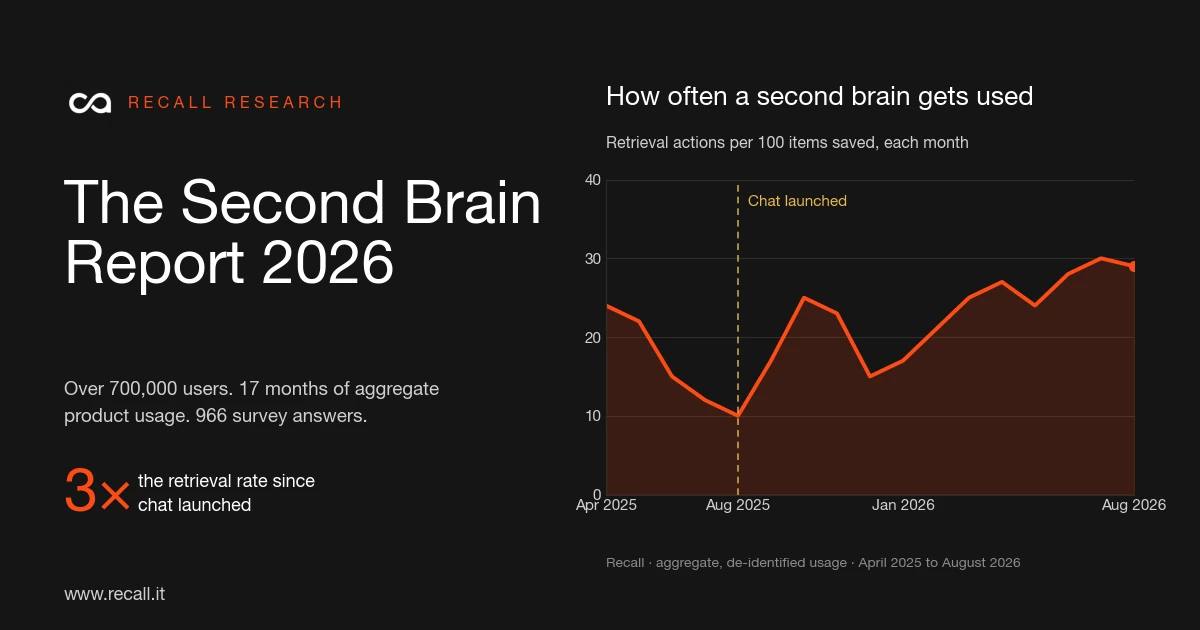
How often a second brain gets used: retrievals per 100 items saved rose from 10 in August 2025, when chat launched, to 30 by August 2026.
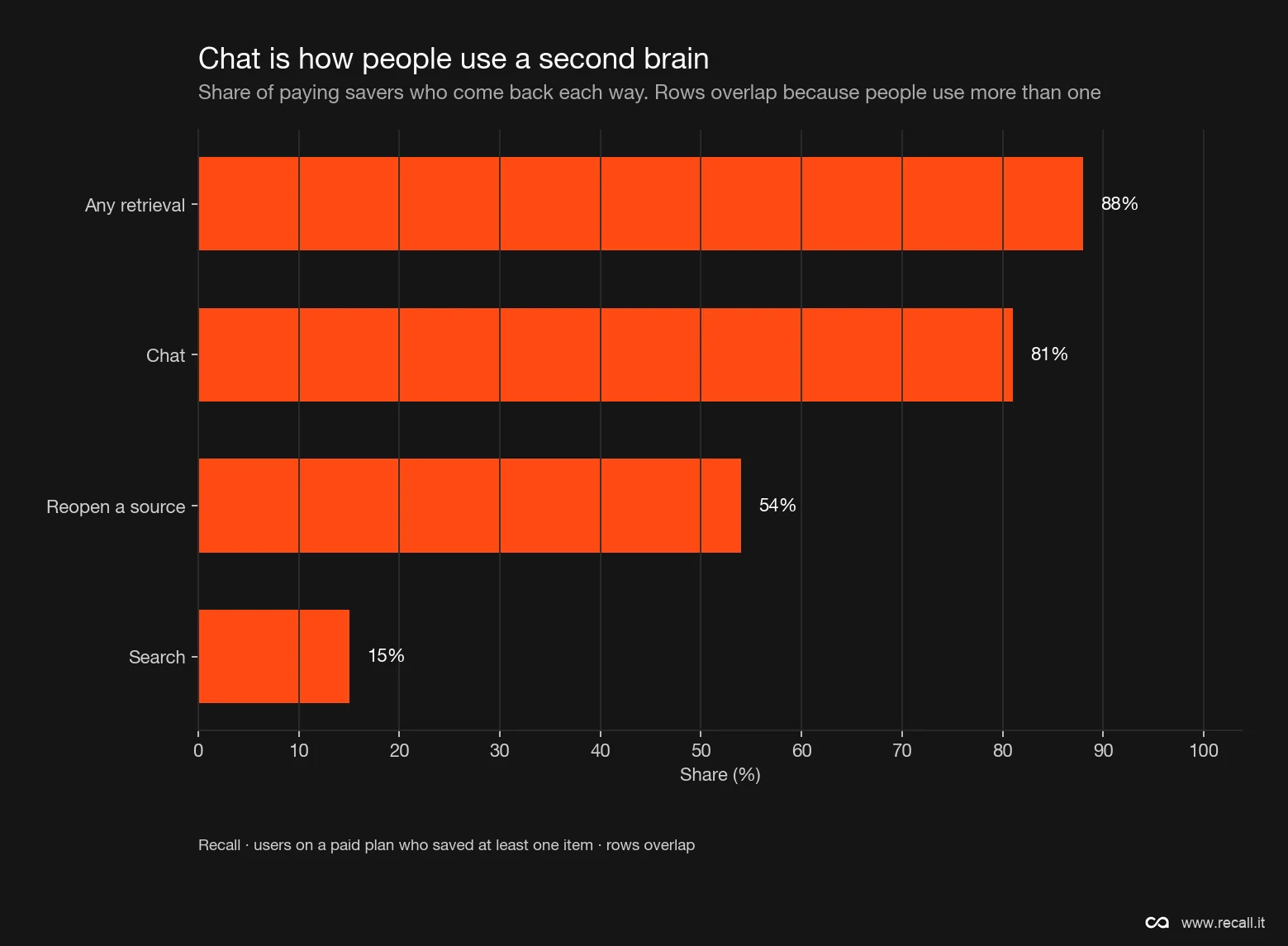
Chat is how people use a second brain: 81% come back by chat, 54% by reopening a source, and 15% by search.
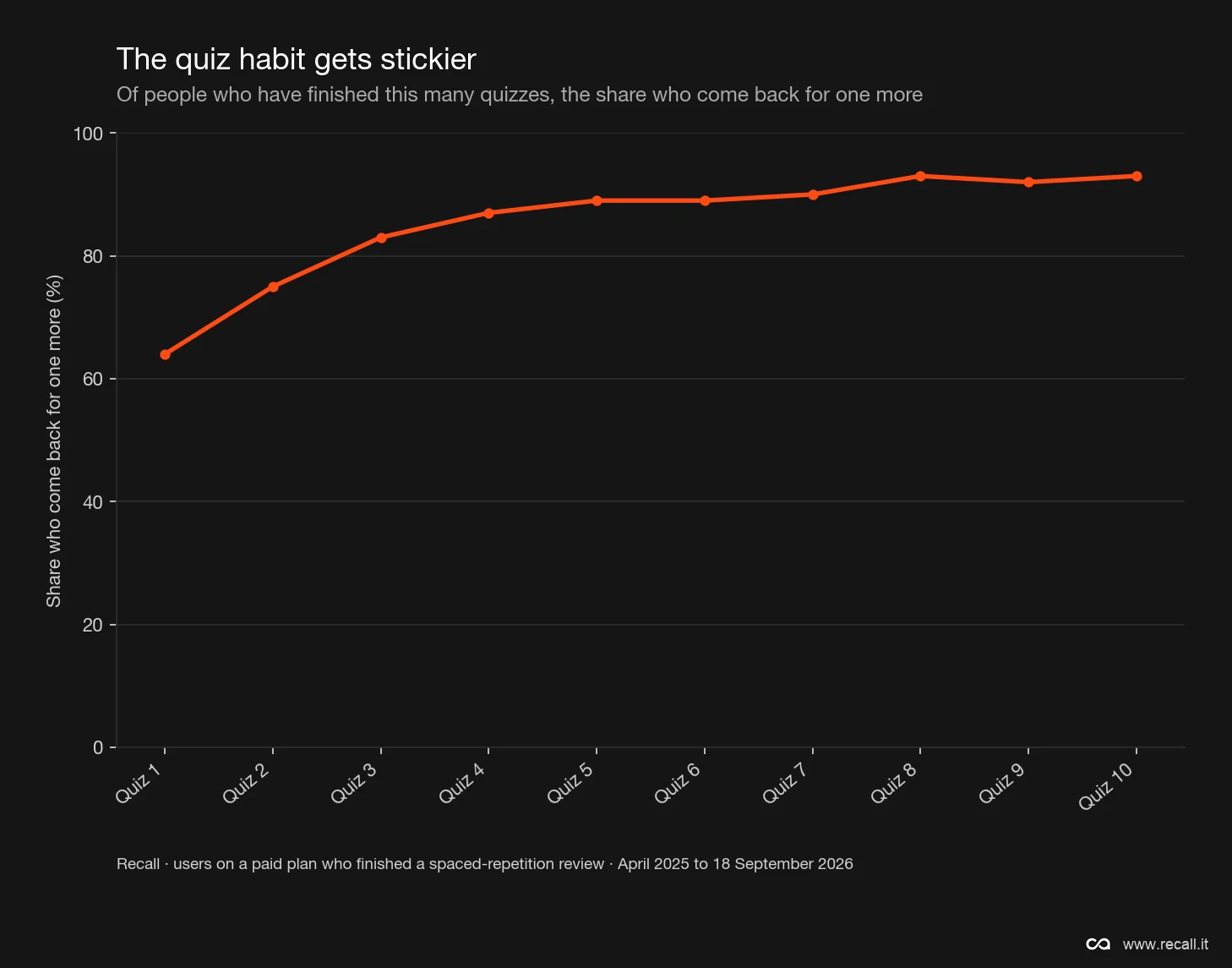
Most people review a second brain more than once: 64% finish a second quiz. From the seventh review on, about 9 in 10 finish another.
Product data from 700K users shows how people build an AI second brain and why natural-language retrieval is changing how they return to saved knowledge
The report examines how to build a second brain that becomes an actively used resource rather than a passive archive. Retrieval rose from 10 actions per 100 saved items in August 2025 to 30 in August 2026. Separately, the share of monthly savers who also retrieved saved content rose from approximately 27 percent in April 2025 to 52 percent in August 2026.
“The fair criticism of second brains was that people saved everything and read nothing,” said Sankari Nair, co-founder and chief operating officer of Recall and author of the report. “Once you can ask your second brain a question, it stops being an archive and becomes something you use. And the answers come from sources you chose yourself.”
Why Building an AI Second Brain Matters Now
A second brain, a concept popularized by productivity author Tiago Forte, is a trusted external library of the articles, videos, podcasts and notes a person wants to remember. The long-standing problem was that filing information took more effort than it returned.
AI is changing that in three ways.
First, retrieval has become a conversation. A library no longer has to be searched to be useful. It can be asked. Second, that library is becoming context for AI, what researcher Andrej Karpathy has called an “LLM wiki.” Third, that context determines what AI answers are built on. Unlike general-purpose AI, which draws on sources users never selected, an AI second brain starts with sources the user chose and keeps the originals available to check.
Three Findings About How People Use an AI Second Brain
1) Chat became the most common route back
Recall introduced chat in August 2025 and expanded it with Recall 2.0 in April 2026, adding chat with an entire library, a single item or the internet. Over that period, retrieval rose from 10 actions per 100 saved items to 30. Among paying users who returned to their libraries, 81 percent used chat, compared with 54 percent who reopened a source and 15 percent who used conventional search.
2) A second brain is closer to a personal syllabus than a notebook
During the report’s 90-day comparison period, YouTube videos made up 49 percent of saved items and web pages 36 percent. Posts from six social platforms accounted for about 6 percent, followed by PDFs. Notes written by users were only 2.5 percent, approximately one in 40 items.
Most of what people saved was material that taught them something. This suggests that people are building personal libraries of knowledge they consume, not simply collections of their own notes.
3) Saving information is not the same as learning it
Finishing a podcast or YouTube video can bring a quick hit of satisfaction, a sense of having learned something. But few people stop to test whether they can actually remember it. Research on the “testing effect” has found that retrieving information from memory supports stronger long-term retention than rereading it. Recall generates quizzes from saved material using active recall, which asks users to answer from memory rather than review, and spaced repetition, which brings questions back at increasing intervals. Among paying users who completed a first quiz, 64 percent returned for a second. Among the smaller, self-selected group who reached a tenth quiz, 93 percent returned again.
Tiago Forte’s Team Tests Recall
Tiago Forte and four members of his team tested Recall on real projects for three weeks. In one comparison, a member of Forte’s team gave Recall and Anthropic’s Claude the same request for content ideas using the same underlying model. The team preferred Recall’s response because it could draw on the exact content the team member had saved. “Your own knowledge, the context only you have gathered, is the fuel for everything AI can do on your behalf,” Forte wrote. “Recall makes that easier than anything else we tried.”
Forte’s full write-up of the test is available at https://fortelabs.com/blog/is-recall-the-second-brain-for-the-ai-era/
How to Build a Second Brain That You Will Actually Use
A second brain is most valuable for people who regularly encounter knowledge they expect to revisit. The report identifies three practical principles:
- Choose a second brain you can talk to. Natural-language chat allows people to retrieve information without remembering an exact folder, title, tag or keyword.
- Make saving effortless. People are more likely to build a useful library when they can save material directly from the page, video or document they are already using. Recall’s YouTube video summarizer, for example, turns a video into a timestamped summary saved straight to the user’s library.
- Test what you want to retain. Saving preserves access to information. Active retrieval helps turn passive consumption into deliberate learning.
Methodology and Limitations
The report analyzes aggregate product data from more than 700,000 users from April 1, 2025, through September 18, 2026, plus 966 voluntary survey responses collected between 2023 and 2026. Saving data covers paying and non-paying users, while retrieval and feature-use findings cover paying users because free-account limits could affect those measures. Recall handled all data in accordance with its Privacy Policy.
About Recall
Recall is an AI second brain and knowledge platform that helps people summarize, organize and retrieve information they want to remember. Users can build a searchable AI second brain from videos, podcasts, web pages, PDFs, ebooks, images, documents, social posts and their own notes. Founded by Paul Richards, Igor Gligorevic and Sankari Nair, Recall has more than 700,000 registered users. It is free to start at www.recall.it.
Sankari Nair
Recall.Wiki Inc
sankari@recall.it
Visit us on social media:
LinkedIn
Instagram
YouTube
TikTok
X
Legal Disclaimer:
EIN Presswire provides this news content "as is" without warranty of any kind. We do not accept any responsibility or liability for the accuracy, content, images, videos, licenses, completeness, legality, or reliability of the information contained in this article. If you have any complaints or copyright issues related to this article, kindly contact the author above.
