

The Autonomous Vehicle Sensors Market Is Expected to Experience Robust Growth Through 2030 at a 21.5% CAGR
Autonomous Vehicle Sensors Market Share
Autonomous Vehicle Sensors Market Forecast
Autonomous Vehicle Sensors Market Industry
The Business Research Company’s Autonomous Vehicle Sensors Global Market Report 2026 – Market Size, Trends, And Forecast 2026-2035
LONDON, GREATER LONDON, UNITED KINGDOM, October 27, 2026 /EINPresswire.com/ -- The Autonomous Vehicle Sensors market is rapidly evolving as autonomous driving technologies gain traction worldwide. With advancements in sensor technology and increasing demand for safer, smarter vehicles, this sector is set for substantial growth in the years ahead. Let’s explore the market size, key growth factors, leading players, and future opportunities shaping this dynamic industry.
Market Size and Position within the Automotive Sensors Industry
The Autonomous Vehicle Sensors market is projected to exceed $12 billion by 2030. When compared to the broader Automotive Sensors market, which is anticipated to reach approximately $63 billion in the same year, autonomous vehicle sensors will constitute about 18% of this parent market. Within the colossal Electrical and Electronics sector, expected to be worth $5,579 billion by 2030, the autonomous vehicle sensors segment will account for close to 0.2% of the total market value.
Request A Free Sample Of The Autonomous Vehicle Sensors Market Report
https://thebusinessresearchcompany.com/sample_request?id=45874351&type=smp&name=Autonomous%20Vehicle%20Sensors%20Market%20Report%202026&utm_source=EINPresswire&utm_medium=Paid&utm_campaign=Oct_PR
North America to Lead in Autonomous Vehicle Sensors by 2030
North America is poised to dominate the autonomous vehicle sensors market in 2030, with a valuation around $5 billion. Starting from $2 billion in 2025, the market is forecasted to grow at a compound annual growth rate (CAGR) of 22%. This rapid expansion is fueled by the swift adoption of advanced driver-assistance systems (ADAS) in both passenger and commercial vehicles. The increasing integration of LiDAR, radar, and camera-based sensor fusion technologies, strong investments from automotive OEMs and Tier-1 suppliers, growth in smart mobility infrastructure, rising emphasis on safety and collision avoidance due to stricter regulations, and innovations in edge computing and real-time sensor data processing across the USA and Canada are key contributors to this growth.
United States Expected to Be the Largest Market by Country
Within the global autonomous vehicle sensors market, the USA is set to be the largest country segment by 2030, valued at $4 billion. Beginning at $1 billion in 2025, it is also projected to grow at a 22% CAGR. This surge is attributed to the expansion of autonomous vehicle testing and robotaxi services, heightened use of advanced sensor fusion technologies, substantial investments from both automotive manufacturers and tech firms, rapid developments in high-precision sensing hardware and semiconductor technologies, expanding smart mobility infrastructure, and supportive regulatory pilots encouraging autonomous driving.
Access The Detailed Autonomous Vehicle Sensors Market Report Here
https://thebusinessresearchcompany.com/report/autonomous-vehicle-sensors-market-report?utm_source=EINPresswire&utm_medium=Paid&utm_campaign=Oct_PR
Hardware Segment to Dominate Autonomous Vehicle Sensors Market
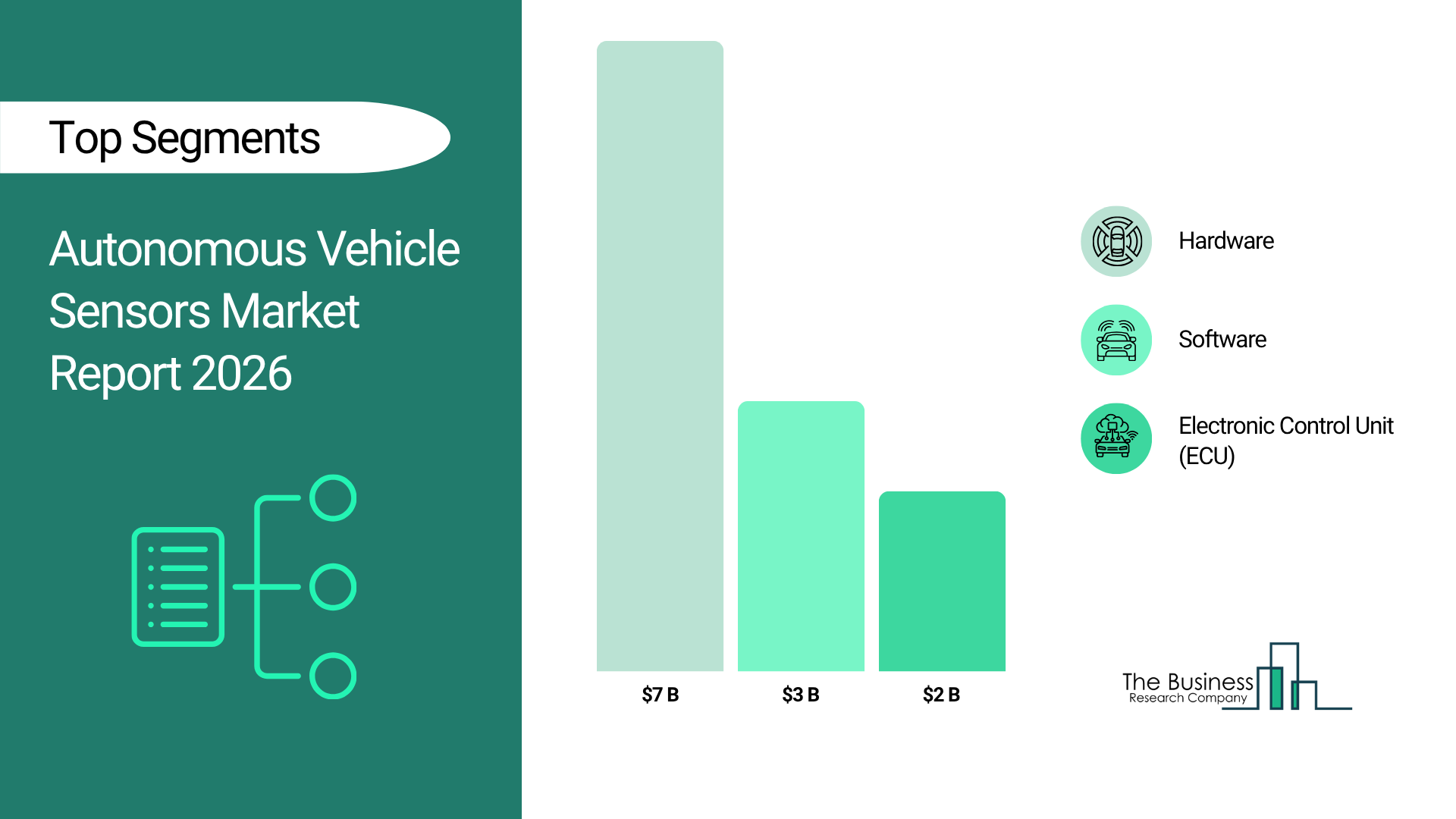
Among the key component categories—hardware, software, and electronic control units (ECU)—hardware will emerge as the largest segment, making up 61% or $7 billion of the total market by 2030. This dominance is supported by ongoing innovations in miniaturized sensor fabrication, growing demand for high-precision semiconductor-based sensors, increased LiDAR and radar production capacities, integration of multi-sensor modules in next-gen autonomous systems, investments in sensor reliability and durability testing, and advancements in edge sensing and real-time signal processing technologies.
Diverse Sensor Types Powering Autonomous Vehicles
The autonomous vehicle sensors market breaks down further by sensor types, including radio detection and ranging (RADAR), light detection and ranging (LiDAR), ultrasound, cameras, and other sensor varieties. Each type plays a crucial role in enabling vehicles to perceive their surroundings accurately.
Vehicle Types and Autonomy Levels Defining Market Segments
In terms of vehicle classification, the market encompasses passenger vehicles, commercial vehicles, two-wheelers, and other vehicle types. Additionally, the market is segmented by autonomy levels ranging from level 1 (driver assistance) up to level 5 (full automation), reflecting the broad spectrum of automation maturity in vehicles today.
Applications Driving Demand for Autonomous Vehicle Sensors
The applications for these sensors include obstacle detection, navigation, collision avoidance, and other specialized uses. These functionalities are vital for enhancing the safety and efficiency of autonomous and semi-autonomous vehicles.
Market Growth Fueled by a Strong CAGR of 21%
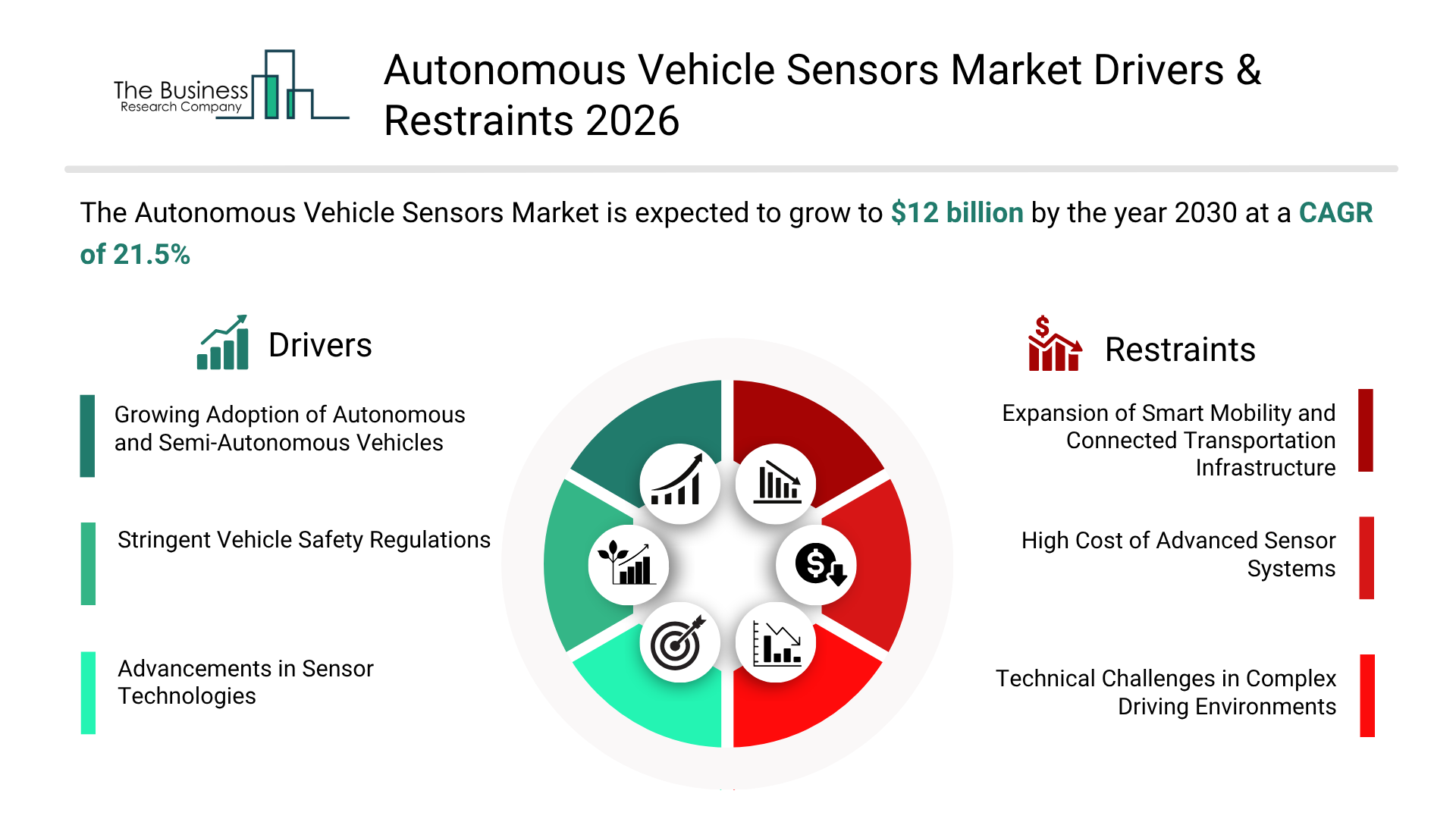
Looking ahead to 2030, the autonomous vehicle sensors market is expected to achieve a compound annual growth rate of 21%, highlighting the sector’s vigorous expansion driven by several pivotal factors.
Increasing Adoption of Autonomous and Semi-Autonomous Vehicles
One primary driver behind this growth is the escalating use of autonomous and semi-autonomous vehicles. As more vehicles incorporate advanced driver assistance systems and autonomous capabilities, the demand for sophisticated sensor technology surges. Automakers are embedding multiple sensors such as LiDAR, radar, cameras, and ultrasonic sensors into their vehicle models. Higher automation levels necessitate greater sensor accuracy and redundancy, further accelerating market expansion at an estimated 2.5% annual growth.
Impact of Stricter Vehicle Safety Regulations
Another critical factor is the introduction of more stringent vehicle safety regulations globally. Governments are enforcing tougher standards aimed at reducing road accidents and fatalities. Features like automatic emergency braking, lane departure warnings, and adaptive cruise control, which rely heavily on advanced sensors, are becoming mandatory. These regulatory pressures encourage automakers to equip vehicles with more sophisticated sensing technologies, contributing to approximately 2.2% annual market growth.
Technological Advancements in Sensor Development
Continuous improvements in sensor technologies also play an essential role in market growth. Innovations in LiDAR, radar, camera, and infrared sensors are enhancing detection accuracy, resolution, and effectiveness even in challenging weather conditions. Miniaturization and integration advancements make sensors more practical for widespread vehicle adoption. The improved reliability and durability of these components support broader commercialization of autonomous vehicles, adding around 2.1% growth annually to the market.
Promising Growth Areas across Hardware, Software, and ECU Markets
Looking at opportunities, the hardware, software, and electronic control unit (ECU) segments are expected to collectively contribute over $7 billion to market value by 2030. This surge is driven by rapid advancements in sensor calibration, validation technologies, perception algorithms, simulation-based testing, predictive maintenance, cybersecurity for connected vehicles, and interoperable sensor integration platforms. These developments are crucial for enhancing system reliability, vehicle safety, and scalable deployment of autonomous driving solutions.
Market Expansion Forecasts from 2025 to 2030
Between 2025 and 2030, the hardware segment is projected to grow by $4 billion, the software segment by $2 billion, and the ECU segment by $1 billion. The market is currently led by a mix of global automotive tech providers and advanced sensor manufacturers, emphasizing LiDAR, radar, camera, ultrasonic sensors, and sensor fusion to improve vehicle perception and decision-making.
Competitive Landscape Featuring Leading Automakers and Technology Firms
Top companies focus on real-time data processing, meeting safety standards, and integrating AI-driven autonomous platforms. Understanding these competitive dynamics is vital for stakeholders aiming to capitalize on growth, innovation, and strategic collaborations in the autonomous mobility space.
Continental AG Takes the Lead in the Market
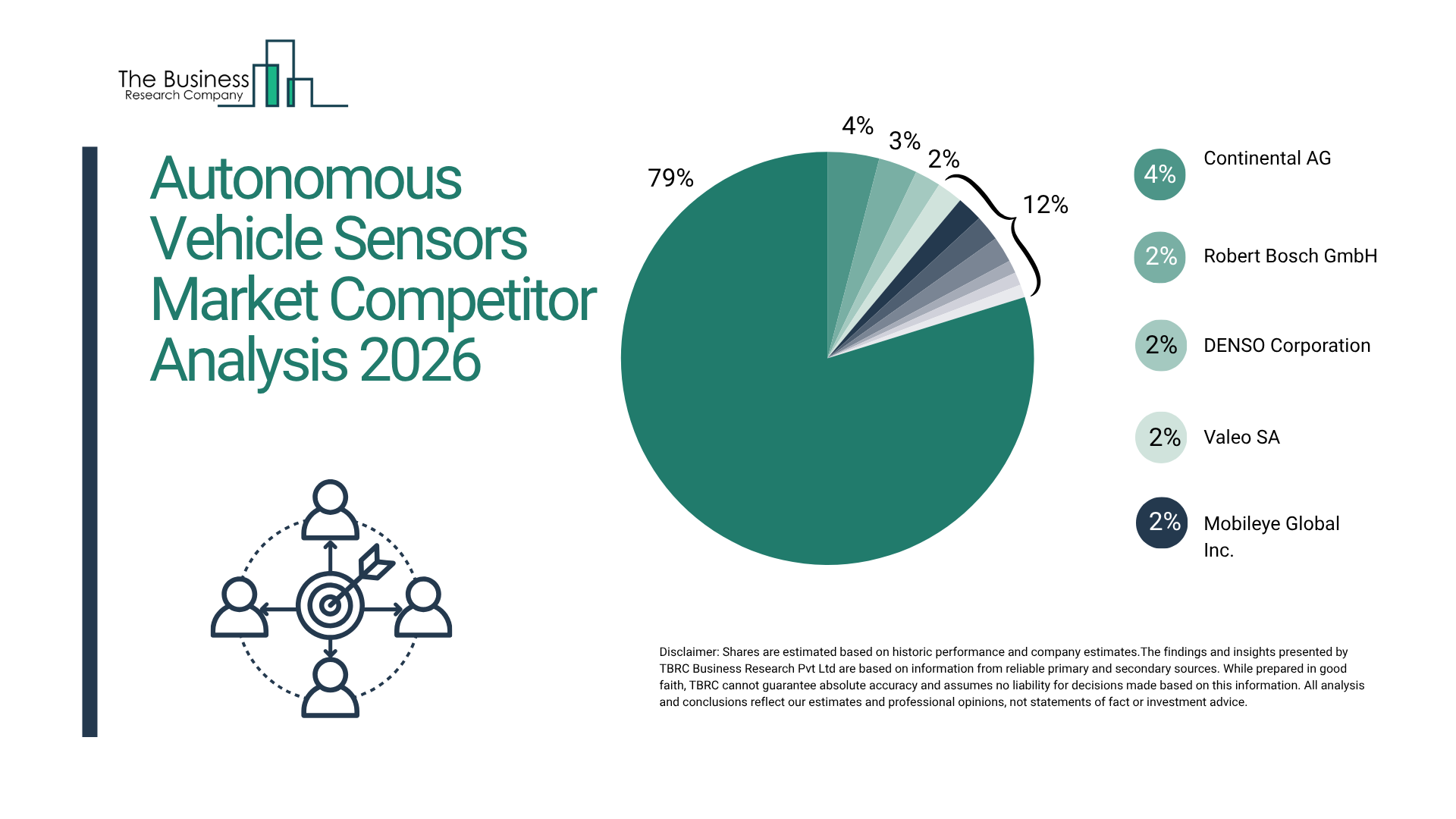
Continental AG stood out as the market leader in 2025, holding a 4% share of global sales. Its automotive sensors division offers an extensive portfolio including radar sensors, LiDAR solutions, camera-based systems, ultrasonic sensors, and sensor fusion technologies that support ADAS and autonomous driving across multiple vehicle segments.
Key Companies Shaping the Autonomous Vehicle Sensors Industry
Other major players include Robert Bosch GmbH, DENSO Corporation, Valeo SA, Mobileye Global Inc., NXP Semiconductors N.V., Aptiv PLC, Infineon Technologies AG, Texas Instruments Incorporated, ON Semiconductor Corporation, Trimble Inc., Nippon Seiki Co. Ltd., Hesai Technology Co. Ltd., Sick AG, Ouster Inc., Aeva Technologies Inc., Cepton Technologies Inc., Brigade Electronics Limited, Quanergy Systems Inc., and Luminar Technologies Inc.
Market Fragmentation and Competitive Dynamics
The autonomous vehicle sensors market features moderate fragmentation, with the top 10 companies accounting for 21% of total revenue in 2025. Barriers to entry are shaped by demanding automotive safety regulations, complex sensor integration, engineering precision requirements, and the necessity for real-time reliability. Leading firms maintain strong market positions through broad product portfolios, established OEM partnerships, global supply networks, and ongoing innovation across radar, LiDAR, camera, and semiconductor sensor technologies. Growth in ADAS, autonomous driving features, real-time perception, and AI-driven sensor fusion will encourage further collaborations, product development, and geographic expansion.
Major Raw Material Suppliers Supporting the Market
Key raw material providers for autonomous vehicle sensors include Robert Bosch GmbH, Continental AG, Denso Corporation, Aptiv PLC, Valeo S.A., Magna International Inc., ZF Friedrichshafen AG, Panasonic Holdings Corporation, Sony Group Corporation, Samsung Electronics Co. Ltd., Texas Instruments Incorporated, NXP Semiconductors N.V., STMicroelectronics N.V., Infineon Technologies AG, Analog Devices Inc., ON Semiconductor Corporation, Renesas Electronics Corporation, Velodyne Lidar Inc., Luminar Technologies Inc., Innoviz Technologies Ltd., Ouster Inc., Hesai Group, Aeva Technologies Inc., Mobileye Global Inc., and Quanergy Systems Inc.
Leading Wholesalers and Distributors in the Autonomous Vehicle Sensors Market
Significant wholesalers and distributors include Arrow Electronics Inc., Avnet Inc., Ingram Micro Inc., Tech Data Corporation, Synnex Corporation, Digi-Key Electronics, Mouser Electronics Inc., Future Electronics Inc., RS Group plc, Newark Electronics, TTI Inc., ScanSource Inc., WESCO International Inc., Rexel S.A., Sonepar Group, ALSO Holding AG, Esprinet S.p.A., Redington Limited, Macnica Inc., EET Group A/S, Bechtle AG, CDW Corporation, Insight Enterprises Inc., Westcon Group, Exclusive Networks SA, and Mindware FZ LLC.
Primary End Users of Autonomous Vehicle Sensors
Key end users include Tesla Inc., Waymo LLC, Cruise LLC, Baidu Apollo Autonomous Driving, Uber Technologies Inc., Lyft Inc., Aurora Innovation Inc., Zoox Inc., Pony.ai Inc., AutoX Technologies Inc., Nuro Inc., Motional LLC, Volvo Car Corporation, General Motors Company, Ford Motor Company, Toyota Motor Corporation, BMW Group, Mercedes-Benz Group AG, Hyundai Motor Company, Nissan Motor Company Limited, Volkswagen AG, Honda Motor Co. Ltd., Kia Corporation, Subaru Corporation, and Renault Group.
Innovations and Trends Shaping Autonomous Vehicle Sensor Technologies
The introduction of frequency modulated continuous wave (FMCW) 4D LiDAR technology is transforming sensor capabilities by enhancing object detection, range accuracy, and real-time perception, enabling higher autonomy levels. For example, in January 2025, Aeva Technologies Inc. released the aeva atlas ultra 4D LiDAR sensor, featuring improved resolution, a wide field of view, and extended detection range for advanced autonomous driving use. Its ability to measure both position and velocity simultaneously enhances object identification speed, situational awareness, and overall safety.
Strategies Employed by Companies to Maintain Market Leadership
Leading firms are advancing LiDAR, radar, and camera sensor technologies to improve detection and safety. They are also leveraging sensor fusion combined with edge AI to boost decision-making and reliability. Expanding autonomous driving sensor suites to enhance vehicle safety and automation, along with integrating AI-driven sensor calibration for greater precision and environmental awareness, remain key strategic priorities.
In summary, the Autonomous Vehicle Sensors market is set for robust growth driven by rising adoption of autonomous vehicles, stringent safety regulations, continuous technological advancements, and strong investments from key industry players. North America, led by the USA, will dominate the market by 2030, while hardware remains the largest segment. With a diverse range of applications and sensor types, the market presents numerous opportunities for innovation and collaboration among major manufacturers, suppliers, distributors, and end users.
Key enhancements in our 2026 market reports include:
• Market attractiveness scoring and analysis
• Total addressable market (TAM) analysis
• Company scoring matrix graphics and tables
• Excel-based forecasting dashboards
• Market hotspots infographics
• Key technologies and future trend analysis
• Updated graphics and tables
Learn More About The Business Research Company
The Business Research Company (www.thebusinessresearchcompany.com) is a leading market intelligence firm renowned for its expertise in company, market, and consumer research. We have published over 30,000+ reports across 27 industries and 60+ geographies. Our research is powered by 1,500,000 datasets, extensive secondary research, and exclusive insights from interviews with industry leaders.
We provide continuous and custom research services, offering a range of specialized packages tailored to your needs, including Market Entry Research Package, Competitor Tracking Package, Supplier & Distributor Package and much more.
Disclaimer: Please note that the findings, conclusions and recommendations that TBRC Business Research Pvt Ltd delivers are based on information gathered in good faith from both primary and secondary sources, whose accuracy we are not always in a position to guarantee. As such TBRC Business Research Pvt Ltd can accept no liability whatever for actions taken based on any information that may subsequently prove to be incorrect. Analysis and findings included in TBRC reports and presentations are our estimates, opinions and are not intended as statements of fact or investment guidance.
Contact Us:
The Business Research Company
Americas +1 310-496-7795
Europe +44 7882 955267
Asia & Others +44 7882 955267 & +91 8897263534
Email: marketing@tbrc.info
Follow Us On:
LinkedIn: https://in.linkedin.com/company/the-business-research-company
Oliver Guirdham
The Business Research Company
7882 955267
Visit us on social media:
LinkedIn
Facebook
X
Legal Disclaimer:
EIN Presswire provides this news content "as is" without warranty of any kind. We do not accept any responsibility or liability for the accuracy, content, images, videos, licenses, completeness, legality, or reliability of the information contained in this article. If you have any complaints or copyright issues related to this article, kindly contact the author above.
