

mEinstein Highlights Consumer Permission in the Evolution of AI-Driven Commerce
News originally published by
EIN Presswire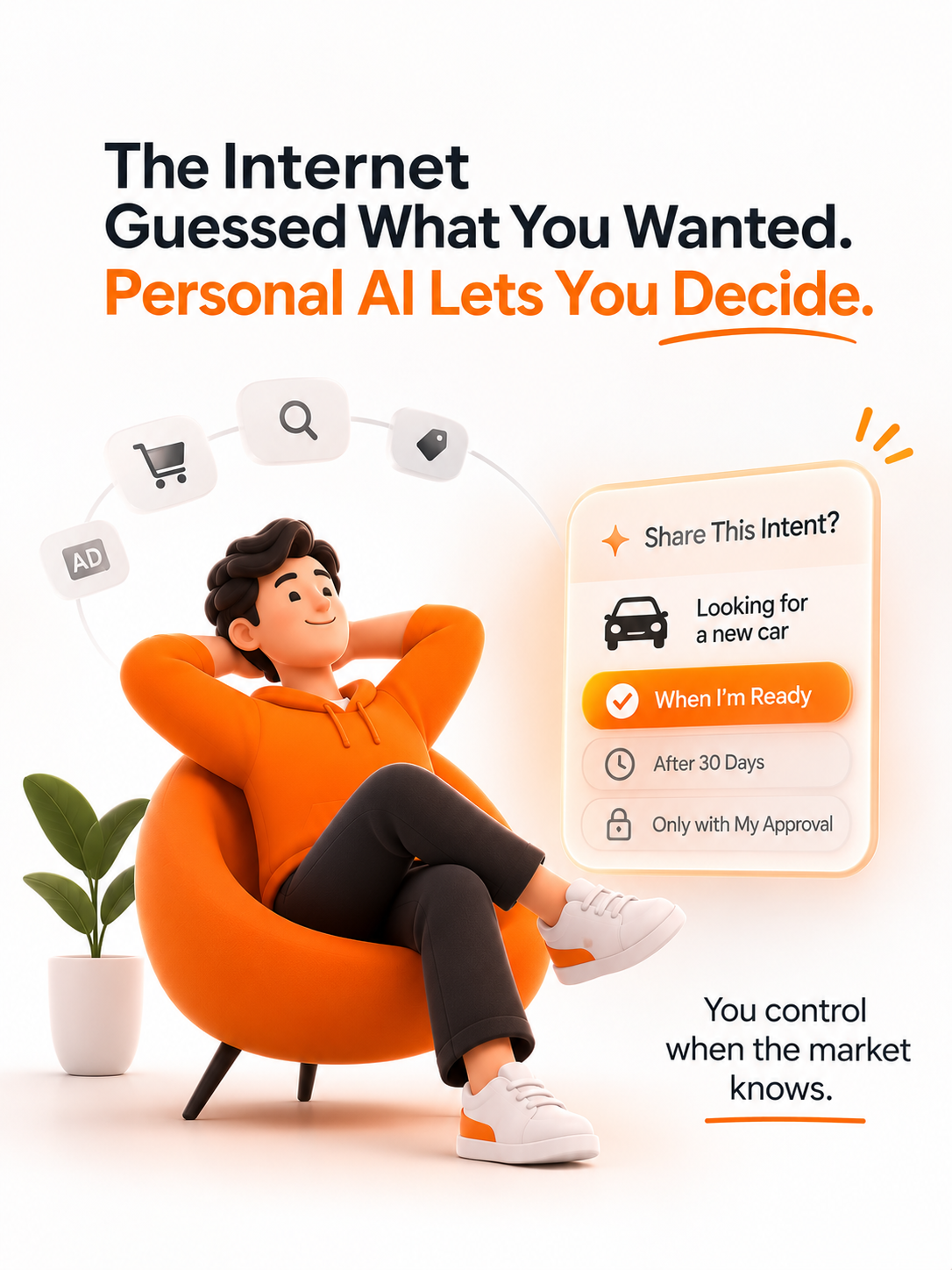
Personal AI could shift advertising from predicting consumer demand to permissioned intent, giving individuals control over when businesses can engage.
The most consumer-aligned thing Personal AI can sometimes do is wait.”
BOSTON, MA, UNITED STATES, November 23, 2026 /EINPresswire.com/ -- For more than two decades, digital advertising has relied on behavioral signals to estimate consumer interests and purchasing decisions. As artificial intelligence increasingly influences product discovery, a different approach to understanding consumer demand is beginning to emerge.— Prithwi R. Thakuria, Founder & CEO of mEinstein
Search activity, browsing histories, transactions, location data and other behavioral indicators have traditionally helped advertisers estimate which consumers may be interested in a product and how close they are to making a purchase.
AI-powered personal assistants could introduce another model, in which consumers communicate their requirements directly through systems designed to understand individual context and act only within authorized boundaries.
“The internet monetized the probability that I might want something,” said Prithwi Thakuria, Founder and CEO of mEinstein. “Personal AI may eventually let me decide when the market is allowed to know that I actually do.”
Recent industry research points to the growing role of AI in consumer discovery.
McKinsey reported in October that 53% of consumers surveyed across 11 markets had used AI for shopping during the previous three months. Among U.S. AI users, the rate of completing purchases through AI had increased 70% from the prior year. AI search was also three times more influential than traditional search among users of AI shopping tools.
Adobe reported that traffic arriving at U.S. retail websites from AI sources in September converted 90% better than non-AI traffic and generated 83% more revenue per visit. AI-referred visitors also spent more time on retailer websites and were more likely to add products to their carts.
These developments suggest that parts of the traditional marketing and discovery process may increasingly take place within AI interactions before consumers reach a retailer.
The change raises questions about how businesses identify purchasing readiness and how much personal information is required to establish genuine consumer interest.
Traditional digital marketing has relied on search terms, audience segments, retargeting and lead-scoring systems to estimate purchase intent. These methods attempt to reduce uncertainty by identifying behavioral patterns associated with potential demand.
Thakuria describes the resulting expenditure as a form of “prediction tax.”
“The market spends enormous amounts trying to determine who is ready,” he said. “Personal AI creates the possibility that the consumer can eventually declare readiness instead.”
In response to this shift, mEinstein has outlined a framework that separates four stages of consumer decision-making: Context, Intent, Readiness and Permissioned Action.
The framework distinguishes between information about an individual's circumstances, the objective being considered, preparedness to act and authorization for external engagement.
The distinction is relevant because an emerging need does not necessarily indicate an immediate purchasing decision. An individual considering replacing an aging vehicle, for example, may first need to compare repair costs, assess affordability and establish vehicle requirements. Awareness of that situation does not automatically constitute permission for dealerships or other businesses to receive the information.
A permission-based approach would separate private preparation from external commercial engagement. Once a consumer establishes readiness, a specific request could communicate relevant requirements, budget, timing and the conditions under which businesses may respond.
Such a request could provide a more direct indication of purchasing intent than behavioral targeting alone.
The approach would not eliminate advertising or other forms of customer acquisition. McKinsey's research into the emerging agentic advertising economy indicates that marketers continue to anticipate an important role for AI in media spending and returns. Brand awareness, product discovery, education and persuasion are likely to remain relevant as AI systems increasingly participate in product selection.
However, the relationship between businesses and consumers could change closer to the point of conversion.
Kantar has identified a broader movement from attention to intention among its 2026 marketing trends, reflecting the growing role of AI agents in helping consumers evaluate and select brands.
This development could create a different path to commercial engagement. Rather than businesses identifying and targeting individuals based on inferred interest, consumers could initiate qualified requests that allow competing businesses to respond within defined conditions.
For enterprises, this could mean receiving less broad personal information while gaining access to more specific requirements and purchasing constraints. The commercial value would depend on the relevance and accuracy of the request, as well as the consumer's authorization to share it.
“The consumer should not become a better-targeted object inside an AI economy,” Thakuria said. “The consumer should become the principal.”
The transition from behavioral prediction to declared intent remains an emerging possibility rather than an established replacement for current advertising models. Its development will depend on how effectively personal AI systems understand individual requirements, distinguish interest from readiness and maintain clear boundaries around information sharing and external action.
As AI becomes more involved in consumer decisions, the ability to identify demand may become only one part of the challenge. Determining when consumers are ready to engage with the market, and under what conditions, may become equally important.
Krati Vyas - Global Market Strategy Leader
mEinstein
Krati.vyas@meinstein.ai
Visit us on social media:
LinkedIn
Instagram
Facebook
YouTube
TikTok
X
Legal Disclaimer:
EIN Presswire provides this news content "as is" without warranty of any kind. We do not accept any responsibility or liability for the accuracy, content, images, videos, licenses, completeness, legality, or reliability of the information contained in this article. If you have any complaints or copyright issues related to this article, kindly contact the author above.
